"Love's Divine"
Then the rainstorm came, over me
And I felt my spirit break
I had lost all of my, belief you see
And realized my mistake
But time threw a prayer, to me
And all around me became still
I need love, love's divine
Please forgive me now I see that I've been blind
Give me love, love is what I need to help me know my name
Through the rainstorm came sanctuary
And I felt my spirit fly
I had found all of my reality
I realize what it takes
'Cause I need love, love's divine
Please forgive me now I see that I've been blind
Give me love, love is what I need to help me know my name
Oh I, don't bend (don't bend), don't break (don't break)
Show me how to live and promise me you won't forsake
'Cause love can help me know my name
Well I try to say there's nothing wrong
But inside I felt me lying all along
But the message here was plain to see
Believe me
'Cause I need love, love's divine
Please forgive me now I see that I've been blind
Give me love, love is what I need to help me know my name
Oh I, don't bend (don't bend), don't break (don't break)
Show me how to live and promise me you won't forsake
'Cause love can help me know my name
Love can help me know my name.
Wednesday, August 7, 2013

Friday, August 2, 2013
Meaning Is Healthier Than Happiness
Meaning Is Healthier Than Happiness
People who are happy but have little-to-no sense of meaning in
their lives have the same gene expression patterns as people who are
enduring chronic adversity.
"Being happy is about feeling good. Meaning is derived from contributing to others or to society in a bigger way. Meaning was defined as an orientation to something bigger than the self. "
For at least the last decade, the happiness craze has been building.
In the last three months alone, over 1,000 books on happiness were
released on Amazon, including Happy Money, Happy-People-Pills For All, and, for those just starting out, Happiness for Beginners.
One of the consistent claims of books like
these is that happiness is associated with all sorts of good life
outcomes, including — most promisingly — good health. Many studies have noted the connection between a happy mind and a healthy body — the
happier you are, the better health outcomes we seem to have. In a
meta-analysis (overview) of 150 studies on this topic, researchers put
it like this: “Inductions of well-being lead to healthy functioning, and
inductions of ill-being lead to compromised health.”
But a new study, just published in the Proceedings of the National Academy of Sciences (PNAS) challenges the rosy picture. Happiness may not be as good for the body as researchers thought. It might even be bad.
Of course, it’s important to first define happiness. A few months ago, I wrote a piece called “There’s More to Life Than Being Happy” about a psychology study
that dug into what happiness really means to people. It specifically
explored the difference between a meaningful life and a happy life.
It seems strange that there would be a
difference at all. But the researchers, who looked at a large sample of
people over a month-long period, found that happiness is associated with
selfish “taking” behavior and that having a sense of meaning in life is associated with selfless “giving” behavior.
"Happiness without meaning characterizes a
relatively shallow, self-absorbed or even selfish life, in which things
go well, needs and desire are easily satisfied, and difficult or taxing
entanglements are avoided," the authors of the study wrote. "If
anything, pure happiness is linked to not helping others in need.” While
being happy is about feeling good, meaning is derived from contributing
to others or to society in a bigger way. As Roy Baumeister, one of the
researchers, told me, "Partly what we do as human beings is to take care
of others and contribute to others. This makes life meaningful but it
does not necessarily make us happy.”
The new PNAS study also sheds light on the
difference between meaning and happiness, but on the biological level.
Barbara Fredrickson, a psychological researcher who specializes in
positive emotions at the University of North Carolina-Chapel Hill, and
Steve Cole, a genetics and psychiatric researcher at UCLA, examined the
self-reported levels of happiness and meaning in 80 research subjects.
Happiness was defined, as in the earlier study, by feeling good.
The researchers measured happiness by asking subjects questions like
“How often did you feel happy?” “How often did you feel interested in
life?” and “How often did you feel satisfied?” The more strongly people
endorsed these measures of “hedonic well-being,” or pleasure, the higher
they scored on happiness.
Meaning was defined as an orientation to
something bigger than the self. They measured meaning by asking
questions like “How often did you feel that your life has a sense of
direction or meaning to it?”, “How often did you feel that you had
something to contribute to society?”, and “How often did you feel that
you belonged to a community/social group?” The more people endorsed
these measures of “eudaimonic well-being” — or, simply put, virtue — the more meaning they felt in life.
After noting the sense of meaning and happiness
that each subject had, Fredrickson and Cole, with their research
colleagues, looked at the ways certain genes expressed themselves in
each of the participants. Like neuroscientists who use fMRI scanning to
determine how regions in the brain respond to different stimuli, Cole
and Fredrickson are interested in how the body, at the genetic level,
responds to feelings of happiness and meaning.
Cole’s past work has linked various kinds of
chronic adversity to a particular gene expression pattern. When people
feel lonely, are grieving the loss of a loved one, or are struggling to
make ends meet, their bodies go into threat mode. This triggers the
activation of a stress-related gene pattern
that has two features: an increase in the activity of proinflammatory
genes and a decrease in the activity of genes involved in anti-viral
responses.
“You have a forward-looking immune system,”
Fredrickson told me, “If you have a long track record of adversity, it
prepares you for bacterial infections. For our ancestors, loneliness and
adversity were associated with bacterial infections from wounds with
predators and fights with conspecifics.” On the other hand, if you are
doing well and having a lot of healthy social connections, your immune
system shifts forward to prepare you for viruses, which you’re more
likely to contract if you're interacting with a lot of people.
What does this have to do with happiness?
Cole and Fredrickson found that people who are happy but have little to no sense of meaning in their lives — proverbially, simply here for the party — have
the same gene expression patterns as people who are responding to and
enduring chronic adversity. That is, the bodies of these happy people
are preparing them for bacterial threats by activating the
pro-inflammatory response. Chronic inflammation is, of course,
associated with major illnesses like heart disease and various cancers.
“Empty positive emotions” — like the kind people experience during manic episodes or artificially induced euphoria from alcohol and drugs — ”are about as good for you for as adversity,” says Fredrickson.
It’s important to understand that for many
people, a sense of meaning and happiness in life overlap; many people
score jointly high (or jointly low) on the happiness and meaning
measures in the study. But for many others, there is a dissonance — they
feel that they are low on happiness and high on meaning or that their
lives are very high in happiness, but low in meaning. This last group,
which has the gene expression pattern associated with adversity, formed a
whopping 75 percent of study participants. Only one quarter of the
study participants had what the researchers call “eudaimonic
predominance” — that is, their sense of meaning outpaced their feelings of happiness.
This is too bad given the more beneficial gene
expression pattern associated with meaningfulness. People whose levels
of happiness and meaning line up, and people who have a strong sense of
meaning but are not necessarily happy, showed a deactivation of the
adversity stress response. Their bodies were not preparing them for the
bacterial infections that we get when we are alone or in trouble, but
for the viral infections we get when surrounded by a lot of other
people.
Fredrickson’s past research, described in her two books, Positivity and Love 2.0,
has mapped the benefits of positive emotions in individuals. She has
found that positive emotions broaden a person’s perspective and buffers people against adversity.
So it was surprising to her that hedonistic well-being, which is
associated with positive emotions and pleasure, did so badly in this
study compared with eudaimonic well-being.
“It’s not the amount of hedonic happiness
that’s a problem,” Fredrickson tells me, “It’s that it’s not matched by
eudaimonic well-being. It’s great when both are in step. But if you have
more hedonic well-being than would be expected, that’s when this [gene]
pattern that’s akin to adversity emerged.”
The terms hedonism and eudaimonism bring to
mind the great philosophical debate, which has shaped Western
civilization for over 2,000 years, about the nature of the good life.
Does happiness lie in feeling good, as hedonists think, or in doing and
being good, as Aristotle and his intellectual descendants, the virtue
ethicists, think? From the evidence of this study, it seems that feeling
good is not enough. People need meaning to thrive. In the words of Carl
Jung, “The least of things with a meaning is worth more in life than
the greatest of things without it.” Jung’s wisdom certainly seems to
apply to our bodies, if not also to our hearts and our minds.

Thursday, August 1, 2013
The Plight of an ADHD Extrovert
The following is a blog from a ballroom dancing addict by the name of Cloud Cray. He is a fantastic dancer. I found out from his blog that he is ADHD and also an extrovert. Interesting read if you read my previous post on introverts.
Cloud's Story
I've
seen a lot of articles popping up about introversion lately. I've
learned a lot from them, but I noticed a recurring theme - there seems
to be a misconception that extroverts have an "easy" time creating
interpersonal relationships. In fact, I would go as far as to say they
are often vilified in these articles, treating others with insensitivity
as they effortlessly feed off the energy of those around them. And
while I may not be the most typical extrovert, I hope my take may help
shed a little light on the plight of other extroverts. Thanks for
reading.
Bump into me around friends or coworkers, and you'll probably find me
cracking jokes, quoting movies, or doing something silly for a bit of
attention. I'm an extrovert - from what I'm told, that means I get my
energy from the people around me. So I try to be around people often
enough that I can get my fix.


For most people, your brain lights up one way if you should do something ("hey, that project is due next week!"), and another part lights up if you want to
do something ("but man, I really want to learn how juggle!"). For ADHD
folks, the first part never lights up. We have to attach a strong
emotion in order to be motivated. We get to our "shoulds" once we are
afraid of the consequences of ignoring them.


Practice doesn't make the task easier. It makes the player better.


I tried to write this article 4 or 5 times. Then, of course, I decided I should try something new. This is my first attempt at cartoons/comics. Hope you enjoyed!
by Cloud Cray
10 Myths About Introverts

10 Myths About Introverts (As a graphic designer, a list I can really get behind…)
Definition of introverts via Wikipedia:
Introverts are people whose energy tends to expand
through reflection and dwindle during interaction. They often take
pleasure in solitary activities such as reading, writing, music,
drawing, tinkering, playing video games, watching movies and plays, and
using computers. The archetypal artist, writer, sculptor, engineer,
composer, and inventor are all highly introverted. An introvert is
likely to enjoy time spent alone and find less reward in time spent with
large groups of people. They prefer to concentrate on a single activity
at a time and like to observe situations before they participate.
Introverts are easily overwhelmed by too much stimulation from social
gatherings and engagement. They are more analytical before speaking.Introversion is not the same as being shy or being a social outcast. Introverts prefer solitary activities over social ones, whereas shy people (who may be extraverts at heart) avoid social encounters out of fear, and the social outcast has little choice in the matter of his or her solitude.
Great list of myths about introverts via Carl King Creative:
Myth #1 – Introverts don’t like to talk.
This is not true. Introverts just don’t talk unless they have something to say. They hate small talk. Get an introvert talking about something they are interested in, and they won’t shut up for days.Myth #2 – Introverts are shy.
Shyness has nothing to do with being an Introvert. Introverts are not necessarily afraid of people. What they need is a reason to interact. They don’t interact for the sake of interacting. If you want to talk to an Introvert, just start talking. Don’t worry about being polite.Myth #3 – Introverts are rude.
Introverts often don’t see a reason for beating around the bush with social pleasantries. They want everyone to just be real and honest. Unfortunately, this is not acceptable in most settings, so Introverts can feel a lot of pressure to fit in, which they find exhausting.Myth #4 – Introverts don’t like people.
On the contrary, Introverts intensely value the few friends they have. They can count their close friends on one hand. If you are lucky enough for an introvert to consider you a friend, you probably have a loyal ally for life. Once you have earned their respect as being a person of substance, you’re in.Myth #5 – Introverts don’t like to go out in public.
Nonsense. Introverts just don’t like to go out in public FOR AS LONG. They also like to avoid the complications that are involved in public activities. They take in data and experiences very quickly, and as a result, don’t need to be there for long to “get it.” They’re ready to go home, recharge, and process it all. In fact, recharging is absolutely crucial for Introverts.Myth #6 – Introverts always want to be alone.
Introverts are perfectly comfortable with their own thoughts. They think a lot. They daydream. They like to have problems to work on, puzzles to solve. But they can also get incredibly lonely if they don’t have anyone to share their discoveries with. They crave an authentic and sincere connection with ONE PERSON at a time.Myth #7 – Introverts are weird.
Introverts are often individualists. They don’t follow the crowd. They’d prefer to be valued for their novel ways of living. They think for themselves and because of that, they often challenge the norm. They don’t make most decisions based on what is popular or trendy.Myth #8 – Introverts are aloof nerds.
Introverts are people who primarily look inward, paying close attention to their thoughts and emotions. It’s not that they are incapable of paying attention to what is going on around them, it’s just that their inner world is much more stimulating and rewarding to them.Myth #9 – Introverts don’t know how to relax and have fun.
Introverts typically relax at home or in nature, not in busy public places. Introverts are not thrill seekers and adrenaline junkies. If there is too much talking and noise going on, they shut down. Their brains are too sensitive to the neurotransmitter called Dopamine. Introverts and Extroverts have different dominant neuro-pathways. Just look it up.Myth #10 – Introverts can fix themselves and become Extroverts.
A world without Introverts would be a world with few scientists, musicians, artists, poets, filmmakers, doctors, mathematicians, writers, and philosophers. That being said, there are still plenty of techniques an Extrovert can learn in order to interact with Introverts. (Yes, I reversed these two terms on purpose to show you how biased our society is.) Introverts cannot “fix themselves” and deserve respect for their natural temperament and contributions to the human race. In fact, one study (Silverman, 1986) showed that the percentage of Introverts increases with IQ.Saturday, July 27, 2013
Women's Circadian Rhythm Beats Faster Than Men's
A new study shows that women run on a different clock than do men.
That is, the biological timekeeper deep in the brain that governs when we sleep and when we wake runs at a faster pace in women. The report, from researchers at Harvard-affiliated Brigham and Women's Hospital, appears in the Proceedings of the National Academy of Sciences.
The results have some interesting implications.
For instance, surveys have shown that women are more likely to identify themselves as early birds, while more men call themselves night owls (although there are lots of exceptions). The new findings may explain why.
Earlier studies have found that women report insomnia about 50 percent more often than men do. Their faster clocks may have something to do with it — or at least with certain types of early-waking insomnia.
Difference Of Six Minutes
The new study was done in 157 people who spent up to eight weeks in a windowless sleep lab in Boston, isolated from all cues about what time it was in the outside world. That allowed their inner clocks to drift according to each person's natural circadian rhythm.
"What we found was that the cycle length of the biological clock in women was shorter on average than it was in men," says Jeanne Duffy, a study author. "The average difference was about six minutes."
She concedes that six minutes doesn't sound like much. But imagine you have a watch that runs six minutes too fast. If you didn't reset it, you'd get more and more out-of-sync with the 24-hour cycle that we all have to live by.
Also, sleep scientists know that even a small variation in people's circadian cycles gets amplified by such factors as when in their cycle light strikes the eye.
By the way, we all have to reset our biological clocks each day, because nobody has an inner clock that's set to exactly 24 hours. (If it was, we couldn't adjust to seasonal differences in the length of nights and days. And jet travel would be a real problem because we couldn't adjust to different time zones.)
Millions Fighting Their Inner Clock
In fact, some women — more than 1 in 3 — have inner clocks that run especially fast. They complete a daily cycle in less than 24 hours.
"If your cycle length is shorter than 24 hours, you need evening light to keep you synchronized," Duffy says. And such people should get blackout shades for the bedroom so morning light is as dim as possible.
That's just the opposite of people whose inner clocks run on a cycle that's longer than 24 hours. They need a dose of morning light to reset their biological clocks, and they should not get too much bright light in the evenings.
Maybe the biggest implication of the study is that there may be millions of women who have to fight against their inner clock every day to do what they need to do.
"I definitely think that's happening out there," says senior study author Charles Czeisler, a professor of sleep medicine and physician at Harvard Medical School.
"I think many women are chronically sleep-deprived because of their work obligations: They're taking care of children, helping them with homework — whatever is happening that can only be done in the evening hours," Czeisler says. "That precludes many women from getting to bed early enough to get a full, sound night of sleep."
No doubt a lot of women can identify with that. But Czeisler also says many women don't see their early-to-bed, early-to-rise tendency as a problem.
"There are many women who really enjoy the fact that they can get up at 4 or 5 o'clock in the morning," he says. "They have peace and quiet. Before the rest of the world wakes up, they can get an extraordinary amount done — and they wouldn't trade it for the world."
Living With Your Circadian Opposite
Czeisler should know. He's married to such a woman: Dr. Theresa Shanahan.
"I am a morning person," she says. "It is a special time in the day that I enjoy ... and always have."
Shanahan says she's at her most productive when the rest of her family is still in bed. "It's wonderful when I've accomplished four or five hours of work and the others are just waking up," she says, laughing. "I've had a good jump on the day."
Her husband likes to stay up late. "I'm definitely an evening type," he says.
Czeisler says when they first got married, he didn't realize they were circadian opposites. "We were so much in love that, you know, we probably didn't even notice the time of day," he says.
That is, the biological timekeeper deep in the brain that governs when we sleep and when we wake runs at a faster pace in women. The report, from researchers at Harvard-affiliated Brigham and Women's Hospital, appears in the Proceedings of the National Academy of Sciences.
The results have some interesting implications.
For instance, surveys have shown that women are more likely to identify themselves as early birds, while more men call themselves night owls (although there are lots of exceptions). The new findings may explain why.
Earlier studies have found that women report insomnia about 50 percent more often than men do. Their faster clocks may have something to do with it — or at least with certain types of early-waking insomnia.
Difference Of Six Minutes
The new study was done in 157 people who spent up to eight weeks in a windowless sleep lab in Boston, isolated from all cues about what time it was in the outside world. That allowed their inner clocks to drift according to each person's natural circadian rhythm.
"What we found was that the cycle length of the biological clock in women was shorter on average than it was in men," says Jeanne Duffy, a study author. "The average difference was about six minutes."
She concedes that six minutes doesn't sound like much. But imagine you have a watch that runs six minutes too fast. If you didn't reset it, you'd get more and more out-of-sync with the 24-hour cycle that we all have to live by.
Also, sleep scientists know that even a small variation in people's circadian cycles gets amplified by such factors as when in their cycle light strikes the eye.
By the way, we all have to reset our biological clocks each day, because nobody has an inner clock that's set to exactly 24 hours. (If it was, we couldn't adjust to seasonal differences in the length of nights and days. And jet travel would be a real problem because we couldn't adjust to different time zones.)
Millions Fighting Their Inner Clock
In fact, some women — more than 1 in 3 — have inner clocks that run especially fast. They complete a daily cycle in less than 24 hours.
"If your cycle length is shorter than 24 hours, you need evening light to keep you synchronized," Duffy says. And such people should get blackout shades for the bedroom so morning light is as dim as possible.
That's just the opposite of people whose inner clocks run on a cycle that's longer than 24 hours. They need a dose of morning light to reset their biological clocks, and they should not get too much bright light in the evenings.
Maybe the biggest implication of the study is that there may be millions of women who have to fight against their inner clock every day to do what they need to do.
"I definitely think that's happening out there," says senior study author Charles Czeisler, a professor of sleep medicine and physician at Harvard Medical School.
"I think many women are chronically sleep-deprived because of their work obligations: They're taking care of children, helping them with homework — whatever is happening that can only be done in the evening hours," Czeisler says. "That precludes many women from getting to bed early enough to get a full, sound night of sleep."
No doubt a lot of women can identify with that. But Czeisler also says many women don't see their early-to-bed, early-to-rise tendency as a problem.
"There are many women who really enjoy the fact that they can get up at 4 or 5 o'clock in the morning," he says. "They have peace and quiet. Before the rest of the world wakes up, they can get an extraordinary amount done — and they wouldn't trade it for the world."
Living With Your Circadian Opposite
Czeisler should know. He's married to such a woman: Dr. Theresa Shanahan.
"I am a morning person," she says. "It is a special time in the day that I enjoy ... and always have."
Shanahan says she's at her most productive when the rest of her family is still in bed. "It's wonderful when I've accomplished four or five hours of work and the others are just waking up," she says, laughing. "I've had a good jump on the day."
Her husband likes to stay up late. "I'm definitely an evening type," he says.
Czeisler says when they first got married, he didn't realize they were circadian opposites. "We were so much in love that, you know, we probably didn't even notice the time of day," he says.
Chow Down In Sync With Your Circadian Clock
We've already nudged you this week about the . And this got us thinking more about the timing of our meals.
There's a growing body of evidence to suggest that when we eat during a 24-hour cycle is likely more important for our health than we realized.
Take, for instance, a study published earlier this year, which we on, that suggests the best way to maximize weight loss is to eat early in the day, not late.
As part of the study, researchers in Spain recruited hundreds of middle-age folks who were overweight, and put them on a diet for five months.
At the end of the study, the folks who'd eaten their main meal of the day before 3 p.m. lost about 5 more pounds than the people who ate a dinner meal later in the evening. (The late eaters were also more likely to eat breakfast.)
What's interesting here is that all the dieters were eating about the same number of calories and had similar levels of physical activity. And the authors concluded that, indeed, the timing of when we eat does seem to matter.
So, what's going on here? Researchers think our body clocks have a lot to do with it.
You see, in addition to the master clock in our brains, there are also little time-keeping clocks in all the organs of our bodies — from our livers and hearts to our guts.
Since these clocks don't work on a perfect 24-hour cycle, they need to be reset each day. Think of it as winding up an old grandfather clock.
Light works as a main cue to reset the brain clock. And scientists say an important reset cue for the mini-clocks in our body is the first bite of food in the morning. It's the biological nudge that says: "Hey, the day has started — wake up and start working."
"When the timing of meals does not match with the sleep-wake cycle well, there's a disconnect between the different clocks that we have in basically all the cells of our body," explained , who directs the Medical Chronobiology Program at Brigham and Women's Hospital in Boston. We spoke to him back in January, when the study was published.
If you listen to my conversation on NPR's Here & Now, you'll also hear how scientist of the Salk Institute explains the likely connections between the timing of meals and the body's ability to process food optimally.
"When the clocks in our body are out of sync," explains Panda, "then our body stores extra energy as fat. And over a long period of time, that can lead to Type 2 diabetes, obesity and increased risk for heart diseases."
So, bottom line, respect the clock. And stay tuned on this topic. More research is on its way.
Don't Blame Your Lousy Night's Sleep On The Moon — Yet
From to seizures, to crime and lack of sleep, people have long
blamed the full moon for a range of problems. Research, on the other
hand, has found over the years to support these anecdotal accounts of the moon's powers over the human body and brain.
But scientists in Switzerland decided to look again at one of those putative effects — disturbed sleep — and were surprised to see there might be something to the claim after all.
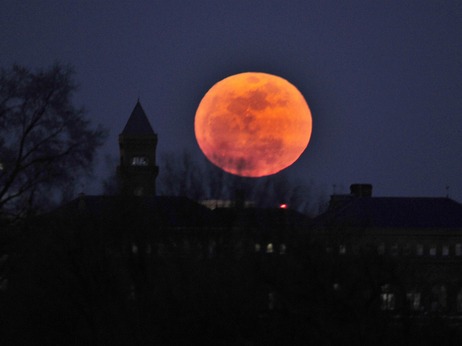 , who studies circadian rhythms and sleep at the University of
Basel, says many friends who work in big sleep clinics tell him their
patients sometimes complain of not being able to sleep during a full
moon. Over drinks one day, he and some colleagues realized they already
had some data that could put that long-held bit of folklore to a test.
"We were sitting outside a pub, and we were looking at the full moon" when they hatched their plan, Cajochen remembers. In an unrelated earlier study, the scientists had collected detailed observations on the sleep patterns of some 30 healthy people — young and old, men and women — as they spent three days sleeping in a lab at various times of the month. The sleepers had been in light-controlled rooms, so were shielded during the study from any changes in daylight — or moonlight — outside the lab, and hadn't been asked anything at all about the moon.
In their current , published this week in Current Biology, Cajochen and his colleague looked back at that old data set and did some number crunching to compare how the people slept at different stages of the lunar cycle.
"We found that people who entered the lab during a full moon slept, on average, 20 minutes less than people who came in during the new moon phase," Cajochen says. Deep sleep was also significantly reduced among people who were in the lab during a full moon, versus those at the lab during a new moon. And the sleep-inducing hormone also declined during a full moon.
Though the results were statistically significant, Cajochen says they might not hold up in a much larger study. And until and unless he or others can replicate the findings and figure out a proposed mechanism for how the moon might have this effect, Cajochen says he's "still skeptical."
So is , a chronobiologist at Northwestern University. "Extraordinary claims require extraordinary evidence," Turek says, adding that the new study falls far short of providing that evidence.
"We don't know whether humans have a clock mechanism that allows us to synchronize our physiology to the lunar cycle," agrees , a sleep researcher at Harvard Medical School. On the other hand, Scheer says, we know a lot about human circadian clocks, which program our bodies to the daily rhythms of day and night. We know where that clock is located in the brain, and we understand some of the neural and molecular pathways involved.
And until someone finds a lunar clock in humans, the mystery of the moon's effect may just be something we have to sleep on.
by Rhitu Chatterjee
But scientists in Switzerland decided to look again at one of those putative effects — disturbed sleep — and were surprised to see there might be something to the claim after all.
Scientists have a new hint of evidence that a full moon can disturb sleep. (And not just because it's romantic.)
"We were sitting outside a pub, and we were looking at the full moon" when they hatched their plan, Cajochen remembers. In an unrelated earlier study, the scientists had collected detailed observations on the sleep patterns of some 30 healthy people — young and old, men and women — as they spent three days sleeping in a lab at various times of the month. The sleepers had been in light-controlled rooms, so were shielded during the study from any changes in daylight — or moonlight — outside the lab, and hadn't been asked anything at all about the moon.
In their current , published this week in Current Biology, Cajochen and his colleague looked back at that old data set and did some number crunching to compare how the people slept at different stages of the lunar cycle.
"We found that people who entered the lab during a full moon slept, on average, 20 minutes less than people who came in during the new moon phase," Cajochen says. Deep sleep was also significantly reduced among people who were in the lab during a full moon, versus those at the lab during a new moon. And the sleep-inducing hormone also declined during a full moon.
Though the results were statistically significant, Cajochen says they might not hold up in a much larger study. And until and unless he or others can replicate the findings and figure out a proposed mechanism for how the moon might have this effect, Cajochen says he's "still skeptical."
So is , a chronobiologist at Northwestern University. "Extraordinary claims require extraordinary evidence," Turek says, adding that the new study falls far short of providing that evidence.
"We don't know whether humans have a clock mechanism that allows us to synchronize our physiology to the lunar cycle," agrees , a sleep researcher at Harvard Medical School. On the other hand, Scheer says, we know a lot about human circadian clocks, which program our bodies to the daily rhythms of day and night. We know where that clock is located in the brain, and we understand some of the neural and molecular pathways involved.
And until someone finds a lunar clock in humans, the mystery of the moon's effect may just be something we have to sleep on.
by Rhitu Chatterjee
Saturday, July 20, 2013
I don't understand my fellow humans
I read this story and I just have no idea why people would do a 180 degree turn.
Why would a gentleman born in a great family, and a Christian faith and has a wife and kids completely turned 180 degree ?
Humans such a complex species. I don't understand what my fellow humans do anyway. :) I learnt new thing everyday and my mind just get blown apart. Why some people's life is so complex :P I get headache just reading it.
By JASMINE BROWN AND ELISSA STOHLER
"I've never encountered somebody who has managed to disappear from their own life," said Robert Anglen, an investigative reporter for the Arizona Republic.
But, in June of 1991, while attending a real estate seminar in San Diego, Eric Myers, 34, pulled off the great escape, disappearing from his life and vanishing without a trace.
For nearly two decades no one knew where Eric Myers was. Police in two states and a private investigator only turned up dead ends.
"Most people grow up thinking that magic is an illusion, and that people can't disappear," said Kirsten Myers Ruggiano, Myers' youngest daughter. "I grew up in a reality where people do disappear."
After being missing for 16 years and being declared legally dead by his family, Eric Myers decided to come back into his family's lives.
"He pulled off the great escape. But he came back. He got away clean, but he came back, and destroyed everybody's life in the process," said Anglen.
Why would a wealthy, successful real estate agent living the American dream just throw everything away?
"I just wanted it all to end. I wanted everything to end," said Myers in an interview with ABC News.
Privileged Beginnings
Eric Myers was the third of five kids born to Don and Joan Myers in a suburb just outside of Phoenix."He had every advantage: the best schools, the best neighborhoods, the best toys," said Anglen.
The conservative, wealthy Myers family lived among luxury homes, picturesque golf courses and influential neighbors.
In high school, Myers was a popular class president who was also considered a class clown. While in college Myers couldn't shake his memories of a sweet girl he knew named Anne.
"When I'm in Washington state, away at school, I realized that the only thing I miss back in Arizona is Anne," said Myers. He proposed to her over the phone.
What appeared to be a storybook marriage was completed by two daughters, Erin and Kirsten.
"I remember him being fun," said Kirsten Myers Ruggiano. "I remember riding on his shoulders."
The family was deeply religious and soon grew to include three adopted boys from Vietnam. While Eric's career, as a property manager in his father's booming real estate business, was taking off, he confided to his friend David Vandervoort that he was in over his head.
"Eric talked about being in debt. Big time. And he was borrowing money from his dad's company to pay it back," said Vandervoort.
And despite picture-perfect appearances, Eric's marriage was on the rocks.
"Anne tells the story of, she wanted to go to college, she wanted to finish the degree, and that ... didn't fit Eric's mold of a Christian housewife," said Anglen.
"Eric searched high and low through the Bible and could not find a way out. So he felt trapped. But yet he was doing the Christian thing by staying married," said Vandervoort.
There was talk of divorce, and on June 25, 1991, as Eric headed to a real estate seminar in San Diego, little did his family know he wouldn't be coming back.
Eric Myers' 'Reset'
"By all accounts it was a reset, it was a, you know, take a deep breath, let's assess what's going on, get away from the situation and maybe come back and see what happens. But of course that's not what happened," said Anglen.There were some hints of foul play as authorities searched for Myers, but they all became dead ends. Eric Myers had completely vanished.
"A healthy, successful American man with a wife and five kids just fell off the face of the earth," said Anglen. "They find out that he checked out of his hotel on the first day of the conference, but continued going. But nobody knows where he is, nobody knows where he went."
Myers' family was left reeling. His youngest daughter was devastated. She said she cried herself to sleep every night for weeks.
"I remember screaming that I wanted him back," said Kirsten Myers Ruggiano.
Ruggiano and her sister were 8 and 10 at the time of their father's disappearance. "I think probably because of my age -- and because I was the youngest -- I think it's safe to say I took it the hardest," said Ruggiano.
But where did Eric Myers go, and how could he leave his wife and children behind?
Eric says he was robbed on the last day of his San Diego business trip, then spent the night in a seedy motel with only a few hundred dollars in his pocket. He says the next morning he woke up and in a swirling moment of emotional despair headed south, to Mexico.
He says the details of his trip are hazy but he remembers crossing the border in Tijuana and buying a bus ticket to Cabo San Lucas. Cabo, with its warm sandy beaches, provided a total escape from a life which he says held a secret that would shake his religious roots to their core.
"At 6 years old, I knew I was attracted, drawn very heavily toward other people my same sex," said Myers.
He turned to religion and at the age of 13 became fervently evangelical, he said.
"That was when I started thinking, This isn't right. I want to be with men," said Myers
When religion didn't work, he thought marrying Anne and starting a family would help. But it didn't, and ultimately the lie caught up with him on that business trip to San Diego, he said. He remembers thinking that at first Cabo would just be a temporary getaway.
"I'm sitting there, saying, You can do this and still go back. You can still do this and still be OK. Maybe a week. Maybe two weeks," said Myers.
But Myers didn't go back. Two weeks turned into four months, and then, without one phone call home, he headed to Palm Springs, Calif.
Myers said that while searching for a new job, he met Sean Lung, a tourist from Canada, and they immediately connected.
Myers and Lung soon moved in together and frequently traveled together. Myers assumed different identities and took odd jobs that didn't require an ID.
All the while, Eric's family was forced to go through life without their father and dad, and in 1996, Myers was declared legally dead. His family cashed in a life insurance policy worth $800,000, and the money was placed in trusts for his two daughters
"I remember screaming that I wanted him back," said Kirsten Myers Ruggiano.
Ruggiano and her sister were 8 and 10 at the time of their father's disappearance. "I think probably because of my age -- and because I was the youngest -- I think it's safe to say I took it the hardest," said Ruggiano.
But where did Eric Myers go, and how could he leave his wife and children behind?
Eric says he was robbed on the last day of his San Diego business trip, then spent the night in a seedy motel with only a few hundred dollars in his pocket. He says the next morning he woke up and in a swirling moment of emotional despair headed south, to Mexico.
He says the details of his trip are hazy but he remembers crossing the border in Tijuana and buying a bus ticket to Cabo San Lucas. Cabo, with its warm sandy beaches, provided a total escape from a life which he says held a secret that would shake his religious roots to their core.
"At 6 years old, I knew I was attracted, drawn very heavily toward other people my same sex," said Myers.
Eric Myers: A New Life
Myers said that because he was gay, he felt forced to create a fake persona from a young age. He said that he believed having a girlfriend would help make him feel how he was "supposed" to feel.He turned to religion and at the age of 13 became fervently evangelical, he said.
"That was when I started thinking, This isn't right. I want to be with men," said Myers
When religion didn't work, he thought marrying Anne and starting a family would help. But it didn't, and ultimately the lie caught up with him on that business trip to San Diego, he said. He remembers thinking that at first Cabo would just be a temporary getaway.
"I'm sitting there, saying, You can do this and still go back. You can still do this and still be OK. Maybe a week. Maybe two weeks," said Myers.
But Myers didn't go back. Two weeks turned into four months, and then, without one phone call home, he headed to Palm Springs, Calif.
Myers said that while searching for a new job, he met Sean Lung, a tourist from Canada, and they immediately connected.
Myers and Lung soon moved in together and frequently traveled together. Myers assumed different identities and took odd jobs that didn't require an ID.
All the while, Eric's family was forced to go through life without their father and dad, and in 1996, Myers was declared legally dead. His family cashed in a life insurance policy worth $800,000, and the money was placed in trusts for his two daughters
Myers said that during that time he tried to avoid thinking about the life he had left behind.
"I cannot say anything to deny that it is the most selfish thing in the world. And I will never be painted as a saint. But no one is all good, and no one is all bad," said Myers.
Myers' daughter Kirsten, now 30, had a hard time not thinking about her missing father. She sought out ways to ease her pain.
"I think I was 11 when I first started stealing wine and realized that it made me feel less sad," said Ruggiano.
She said she spent years struggling with addiction and got sober largely to lessen the burden on her mother.
"My mother is one of the most selfless people I've ever met," said Ruggiano. "If either my sister or I called her and said, I need you here now, she would absolutely drop everything to be by our side as soon as she needed to."
Anne Myers helped her family cope with their loss throughout the years. Together they celebrated birthdays, proms and graduations -- all without their dad and husband.
In 2007, 16 years after Myers disappeared, cryptic email messages started to show up in the inboxes of Myers' friends and family. "Would you be curious in knowing what happened to Eric Myers?" read one.
Sixteen years after disappearing, Myers reappeared.
"There was never any plan to come back, just like there was never any plan to leave, and it just happened," said Myers.
Through a friend, Myers arranged to reconnect with his mother, Joan Myers. He said she welcomed him back with open arms.
"My mother and I were past it with one hug," said Myers.
Today Myers has reconnected with most of his siblings. Myers and Lung moved in with Myers' parents and helped care for his father in the last few years of his life.
The return dealt a severe blow to Myers' now ex-wife and his children, especially his youngest daughter, a mother of two who had finally found happiness and peace in her life.
Eric Myers: Return Brings Lawsuit, Fresh Pain
"I know how much I love my children," said Ruggiano. "And if he loved me even half as much as I loved them, there would be no situation where he would ever think that it was okay to leave me."Ruggiano has only glimpsed her father once since he returned. She has not spoken to him.
When Liberty Life Insurance, the company that had paid the death benefit, learned that Eric Myers was alive, they successfully sued the Myers family for the $800,000 plus interest, and the family is now appealing -- another reason why Myers' return has thrown the family into emotional turmoil.
"It almost hurt more to have him come back than it did for him to go in the first place," said Ruggiano.
Despite the painful consequences, Myers insisted he made the right decision to return.
"To live in a disguise is a horrible prison," said Myers.
To Ruggiano, her father saying that he left because he was gay does not make up for all of the years lost.
"I know a lot of people who would never do this … absolutely never blame it on their homosexuality. I don't believe that he is capable of love," said Ruggiano.
Saturday, July 13, 2013
How Doctors Die
By 
Years ago, Charlie, a highly respected orthopedist and a mentor of mine, found a lump in his stomach. He had a surgeon explore the area, and the diagnosis was pancreatic cancer. This surgeon was one of the best in the country. He had even invented a new procedure for this exact cancer that could triple a patient’s five-year-survival odds—from 5 percent to 15 percent—albeit with a poor quality of life. Charlie was uninterested. He went home the next day, closed his practice, and never set foot in a hospital again. He focused on spending time with family and feeling as good as possible. Several months later, he died at home. He got no chemotherapy, radiation, or surgical treatment. Medicare didn’t spend much on him.
It’s not a frequent topic of discussion, but doctors die, too. And they don’t die like the rest of us. What’s unusual about them is not how much treatment they get compared to most Americans, but how little. For all the time they spend fending off the deaths of others, they tend to be fairly serene when faced with death themselves. They know exactly what is going to happen, they know the choices, and they generally have access to any sort of medical care they could want. But they go gently.
Of course, doctors don’t want to die; they want to live. But they know enough about modern medicine to know its limits. And they know enough about death to know what all people fear most: dying in pain, and dying alone. They’ve talked about this with their families. They want to be sure, when the time comes, that no heroic measures will happen—that they will never experience, during their last moments on earth, someone breaking their ribs in an attempt to resuscitate them with CPR (that’s what happens if CPR is done right).
Almost all medical professionals have seen what we call “futile care” being performed on people. That’s when doctors bring the cutting edge of technology to bear on a grievously ill person near the end of life. The patient will get cut open, perforated with tubes, hooked up to machines, and assaulted with drugs. All of this occurs in the Intensive Care Unit at a cost of tens of thousands of dollars a day. What it buys is misery we would not inflict on a terrorist. I cannot count the number of times fellow physicians have told me, in words that vary only slightly, “Promise me if you find me like this that you’ll kill me.” They mean it. Some medical personnel wear medallions stamped “NO CODE” to tell physicians not to perform CPR on them. I have even seen it as a tattoo.
To administer medical care that makes people suffer is anguishing. Physicians are trained to gather information without revealing any of their own feelings, but in private, among fellow doctors, they’ll vent. “How can anyone do that to their family members?” they’ll ask. I suspect it’s one reason physicians have higher rates of alcohol abuse and depression than professionals in most other fields. I know it’s one reason I stopped participating in hospital care for the last 10 years of my practice.
How has it come to this—that doctors administer so much care that they wouldn’t want for themselves? The simple, or not-so-simple, answer is this: patients, doctors, and the system.
To see how patients play a role, imagine a scenario in which someone has lost consciousness and been admitted to an emergency room. As is so often the case, no one has made a plan for this situation, and shocked and scared family members find themselves caught up in a maze of choices. They’re overwhelmed. When doctors ask if they want “everything” done, they answer yes. Then the nightmare begins. Sometimes, a family really means “do everything,” but often they just mean “do everything that’s reasonable.” The problem is that they may not know what’s reasonable, nor, in their confusion and sorrow, will they ask about it or hear what a physician may be telling them. For their part, doctors told to do “everything” will do it, whether it is reasonable or not.
The above scenario is a common one. Feeding into the problem are unrealistic expectations of what doctors can accomplish. Many people think of CPR as a reliable lifesaver when, in fact, the results are usually poor. I’ve had hundreds of people brought to me in the emergency room after getting CPR. Exactly one, a healthy man who’d had no heart troubles (for those who want specifics, he had a “tension pneumothorax”), walked out of the hospital. If a patient suffers from severe illness, old age, or a terminal disease, the odds of a good outcome from CPR are infinitesimal, while the odds of suffering are overwhelming. Poor knowledge and misguided expectations lead to a lot of bad decisions.
But of course it’s not just patients making these things happen. Doctors play an enabling role, too. The trouble is that even doctors who hate to administer futile care must find a way to address the wishes of patients and families. Imagine, once again, the emergency room with those grieving, possibly hysterical, family members. They do not know the doctor. Establishing trust and confidence under such circumstances is a very delicate thing. People are prepared to think the doctor is acting out of base motives, trying to save time, or money, or effort, especially if the doctor is advising against further treatment.
Some doctors are stronger communicators than others, and some doctors are more adamant, but the pressures they all face are similar. When I faced circumstances involving end-of-life choices, I adopted the approach of laying out only the options that I thought were reasonable (as I would in any situation) as early in the process as possible. When patients or families brought up unreasonable choices, I would discuss the issue in layman’s terms that portrayed the downsides clearly. If patients or families still insisted on treatments I considered pointless or harmful, I would offer to transfer their care to another doctor or hospital.
Should I have been more forceful at times? I know that some of those transfers still haunt me. One of the patients of whom I was most fond was an attorney from a famous political family. She had severe diabetes and terrible circulation, and, at one point, she developed a painful sore on her foot. Knowing the hazards of hospitals, I did everything I could to keep her from resorting to surgery. Still, she sought out outside experts with whom I had no relationship. Not knowing as much about her as I did, they decided to perform bypass surgery on her chronically clogged blood vessels in both legs. This didn’t restore her circulation, and the surgical wounds wouldn’t heal. Her feet became gangrenous, and she endured bilateral leg amputations. Two weeks later, in the famous medical center in which all this had occurred, she died.
It’s easy to find fault with both doctors and patients in such stories, but in many ways all the parties are simply victims of a larger system that encourages excessive treatment. In some unfortunate cases, doctors use the fee-for-service model to do everything they can, no matter how pointless, to make money. More commonly, though, doctors are fearful of litigation and do whatever they’re asked, with little feedback, to avoid getting in trouble.
Even when the right preparations have been made, the system can still swallow people up. One of my patients was a man named Jack, a 78-year-old who had been ill for years and undergone about 15 major surgical procedures. He explained to me that he never, under any circumstances, wanted to be placed on life support machines again. One Saturday, however, Jack suffered a massive stroke and got admitted to the emergency room unconscious, without his wife. Doctors did everything possible to resuscitate him and put him on life support in the ICU. This was Jack’s worst nightmare. When I arrived at the hospital and took over Jack’s care, I spoke to his wife and to hospital staff, bringing in my office notes with his care preferences. Then I turned off the life support machines and sat with him. He died two hours later.
Even with all his wishes documented, Jack hadn’t died as he’d hoped. The system had intervened. One of the nurses, I later found out, even reported my unplugging of Jack to the authorities as a possible homicide. Nothing came of it, of course; Jack’s wishes had been spelled out explicitly, and he’d left the paperwork to prove it. But the prospect of a police investigation is terrifying for any physician. I could far more easily have left Jack on life support against his stated wishes, prolonging his life, and his suffering, a few more weeks. I would even have made a little more money, and Medicare would have ended up with an additional $500,000 bill. It’s no wonder many doctors err on the side of overtreatment.
But doctors still don’t over-treat themselves. They see the consequences of this constantly. Almost anyone can find a way to die in peace at home, and pain can be managed better than ever. Hospice care, which focuses on providing terminally ill patients with comfort and dignity rather than on futile cures, provides most people with much better final days. Amazingly, studies have found that people placed in hospice care often live longer than people with the same disease who are seeking active cures. I was struck to hear on the radio recently that the famous reporter Tom Wicker had “died peacefully at home, surrounded by his family.” Such stories are, thankfully, increasingly common.
Several years ago, my older cousin Torch (born at home by the light of a flashlight—or torch) had a seizure that turned out to be the result of lung cancer that had gone to his brain. I arranged for him to see various specialists, and we learned that with aggressive treatment of his condition, including three to five hospital visits a week for chemotherapy, he would live perhaps four months. Ultimately, Torch decided against any treatment and simply took pills for brain swelling. He moved in with me.
We spent the next eight months doing a bunch of things that he enjoyed, having fun together like we hadn’t had in decades. We went to Disneyland, his first time. We’d hang out at home. Torch was a sports nut, and he was very happy to watch sports and eat my cooking. He even gained a bit of weight, eating his favorite foods rather than hospital foods. He had no serious pain, and he remained high-spirited. One day, he didn’t wake up. He spent the next three days in a coma-like sleep and then died. The cost of his medical care for those eight months, for the one drug he was taking, was about $20.
Torch was no doctor, but he knew he wanted a life of quality, not just quantity. Don’t most of us? If there is a state of the art of end-of-life care, it is this: death with dignity. As for me, my physician has my choices. They were easy to make, as they are for most physicians. There will be no heroics, and I will go gentle into that good night. Like my mentor Charlie. Like my cousin Torch. Like my fellow doctors.
Ken Murray, MD, is Clinical Assistant Professor of Family Medicine at USC. This post was originally published at Zócalo Public Square, a non-profit ideas exchange that blends live events and humanities journalism.
Years ago, Charlie, a highly respected orthopedist and a mentor of mine, found a lump in his stomach. He had a surgeon explore the area, and the diagnosis was pancreatic cancer. This surgeon was one of the best in the country. He had even invented a new procedure for this exact cancer that could triple a patient’s five-year-survival odds—from 5 percent to 15 percent—albeit with a poor quality of life. Charlie was uninterested. He went home the next day, closed his practice, and never set foot in a hospital again. He focused on spending time with family and feeling as good as possible. Several months later, he died at home. He got no chemotherapy, radiation, or surgical treatment. Medicare didn’t spend much on him.
It’s not a frequent topic of discussion, but doctors die, too. And they don’t die like the rest of us. What’s unusual about them is not how much treatment they get compared to most Americans, but how little. For all the time they spend fending off the deaths of others, they tend to be fairly serene when faced with death themselves. They know exactly what is going to happen, they know the choices, and they generally have access to any sort of medical care they could want. But they go gently.
Of course, doctors don’t want to die; they want to live. But they know enough about modern medicine to know its limits. And they know enough about death to know what all people fear most: dying in pain, and dying alone. They’ve talked about this with their families. They want to be sure, when the time comes, that no heroic measures will happen—that they will never experience, during their last moments on earth, someone breaking their ribs in an attempt to resuscitate them with CPR (that’s what happens if CPR is done right).
Almost all medical professionals have seen what we call “futile care” being performed on people. That’s when doctors bring the cutting edge of technology to bear on a grievously ill person near the end of life. The patient will get cut open, perforated with tubes, hooked up to machines, and assaulted with drugs. All of this occurs in the Intensive Care Unit at a cost of tens of thousands of dollars a day. What it buys is misery we would not inflict on a terrorist. I cannot count the number of times fellow physicians have told me, in words that vary only slightly, “Promise me if you find me like this that you’ll kill me.” They mean it. Some medical personnel wear medallions stamped “NO CODE” to tell physicians not to perform CPR on them. I have even seen it as a tattoo.
To administer medical care that makes people suffer is anguishing. Physicians are trained to gather information without revealing any of their own feelings, but in private, among fellow doctors, they’ll vent. “How can anyone do that to their family members?” they’ll ask. I suspect it’s one reason physicians have higher rates of alcohol abuse and depression than professionals in most other fields. I know it’s one reason I stopped participating in hospital care for the last 10 years of my practice.
How has it come to this—that doctors administer so much care that they wouldn’t want for themselves? The simple, or not-so-simple, answer is this: patients, doctors, and the system.
To see how patients play a role, imagine a scenario in which someone has lost consciousness and been admitted to an emergency room. As is so often the case, no one has made a plan for this situation, and shocked and scared family members find themselves caught up in a maze of choices. They’re overwhelmed. When doctors ask if they want “everything” done, they answer yes. Then the nightmare begins. Sometimes, a family really means “do everything,” but often they just mean “do everything that’s reasonable.” The problem is that they may not know what’s reasonable, nor, in their confusion and sorrow, will they ask about it or hear what a physician may be telling them. For their part, doctors told to do “everything” will do it, whether it is reasonable or not.
The above scenario is a common one. Feeding into the problem are unrealistic expectations of what doctors can accomplish. Many people think of CPR as a reliable lifesaver when, in fact, the results are usually poor. I’ve had hundreds of people brought to me in the emergency room after getting CPR. Exactly one, a healthy man who’d had no heart troubles (for those who want specifics, he had a “tension pneumothorax”), walked out of the hospital. If a patient suffers from severe illness, old age, or a terminal disease, the odds of a good outcome from CPR are infinitesimal, while the odds of suffering are overwhelming. Poor knowledge and misguided expectations lead to a lot of bad decisions.
But of course it’s not just patients making these things happen. Doctors play an enabling role, too. The trouble is that even doctors who hate to administer futile care must find a way to address the wishes of patients and families. Imagine, once again, the emergency room with those grieving, possibly hysterical, family members. They do not know the doctor. Establishing trust and confidence under such circumstances is a very delicate thing. People are prepared to think the doctor is acting out of base motives, trying to save time, or money, or effort, especially if the doctor is advising against further treatment.
Some doctors are stronger communicators than others, and some doctors are more adamant, but the pressures they all face are similar. When I faced circumstances involving end-of-life choices, I adopted the approach of laying out only the options that I thought were reasonable (as I would in any situation) as early in the process as possible. When patients or families brought up unreasonable choices, I would discuss the issue in layman’s terms that portrayed the downsides clearly. If patients or families still insisted on treatments I considered pointless or harmful, I would offer to transfer their care to another doctor or hospital.
Should I have been more forceful at times? I know that some of those transfers still haunt me. One of the patients of whom I was most fond was an attorney from a famous political family. She had severe diabetes and terrible circulation, and, at one point, she developed a painful sore on her foot. Knowing the hazards of hospitals, I did everything I could to keep her from resorting to surgery. Still, she sought out outside experts with whom I had no relationship. Not knowing as much about her as I did, they decided to perform bypass surgery on her chronically clogged blood vessels in both legs. This didn’t restore her circulation, and the surgical wounds wouldn’t heal. Her feet became gangrenous, and she endured bilateral leg amputations. Two weeks later, in the famous medical center in which all this had occurred, she died.
It’s easy to find fault with both doctors and patients in such stories, but in many ways all the parties are simply victims of a larger system that encourages excessive treatment. In some unfortunate cases, doctors use the fee-for-service model to do everything they can, no matter how pointless, to make money. More commonly, though, doctors are fearful of litigation and do whatever they’re asked, with little feedback, to avoid getting in trouble.
Even when the right preparations have been made, the system can still swallow people up. One of my patients was a man named Jack, a 78-year-old who had been ill for years and undergone about 15 major surgical procedures. He explained to me that he never, under any circumstances, wanted to be placed on life support machines again. One Saturday, however, Jack suffered a massive stroke and got admitted to the emergency room unconscious, without his wife. Doctors did everything possible to resuscitate him and put him on life support in the ICU. This was Jack’s worst nightmare. When I arrived at the hospital and took over Jack’s care, I spoke to his wife and to hospital staff, bringing in my office notes with his care preferences. Then I turned off the life support machines and sat with him. He died two hours later.
Even with all his wishes documented, Jack hadn’t died as he’d hoped. The system had intervened. One of the nurses, I later found out, even reported my unplugging of Jack to the authorities as a possible homicide. Nothing came of it, of course; Jack’s wishes had been spelled out explicitly, and he’d left the paperwork to prove it. But the prospect of a police investigation is terrifying for any physician. I could far more easily have left Jack on life support against his stated wishes, prolonging his life, and his suffering, a few more weeks. I would even have made a little more money, and Medicare would have ended up with an additional $500,000 bill. It’s no wonder many doctors err on the side of overtreatment.
But doctors still don’t over-treat themselves. They see the consequences of this constantly. Almost anyone can find a way to die in peace at home, and pain can be managed better than ever. Hospice care, which focuses on providing terminally ill patients with comfort and dignity rather than on futile cures, provides most people with much better final days. Amazingly, studies have found that people placed in hospice care often live longer than people with the same disease who are seeking active cures. I was struck to hear on the radio recently that the famous reporter Tom Wicker had “died peacefully at home, surrounded by his family.” Such stories are, thankfully, increasingly common.
Several years ago, my older cousin Torch (born at home by the light of a flashlight—or torch) had a seizure that turned out to be the result of lung cancer that had gone to his brain. I arranged for him to see various specialists, and we learned that with aggressive treatment of his condition, including three to five hospital visits a week for chemotherapy, he would live perhaps four months. Ultimately, Torch decided against any treatment and simply took pills for brain swelling. He moved in with me.
We spent the next eight months doing a bunch of things that he enjoyed, having fun together like we hadn’t had in decades. We went to Disneyland, his first time. We’d hang out at home. Torch was a sports nut, and he was very happy to watch sports and eat my cooking. He even gained a bit of weight, eating his favorite foods rather than hospital foods. He had no serious pain, and he remained high-spirited. One day, he didn’t wake up. He spent the next three days in a coma-like sleep and then died. The cost of his medical care for those eight months, for the one drug he was taking, was about $20.
Torch was no doctor, but he knew he wanted a life of quality, not just quantity. Don’t most of us? If there is a state of the art of end-of-life care, it is this: death with dignity. As for me, my physician has my choices. They were easy to make, as they are for most physicians. There will be no heroics, and I will go gentle into that good night. Like my mentor Charlie. Like my cousin Torch. Like my fellow doctors.
Ken Murray, MD, is Clinical Assistant Professor of Family Medicine at USC. This post was originally published at Zócalo Public Square, a non-profit ideas exchange that blends live events and humanities journalism.
Sunday, June 30, 2013
Is happiness enough?

|
A POINT OF VIEW
By Clive James |

 In an early Robert Redford starring vehicle called The Candidate, which
is now largely forgotten but shouldn't be - watch and marvel as he uses
all four facial expressions - there is an interchange of dialogue which
encapsulates a nagging philosophical problem.
Redford has pointed out that if he runs for office he will never be happy again, and his prospective campaign manager says: "Clams are happy."
Redford decides that he is a more complex mechanism than a clam - some critics of his acting might think he reaches this decision too hastily - and runs for office.
The implication is that happiness, in itself, is no worthwhile aim in human life. Certainly TE Lawrence didn't think so. It was TE Lawrence who bowled over the young CV James by insisting in print that happiness was "a by-product of absorption".
Peter O'Toole didn't actually say this when he impersonated TE Lawrence on screen in Lawrence of Arabia. Always one of the most cultivated among actors, O'Toole, as his autobiography Loitering With Intent proves, wields a prose style considerably more notable for clarity and rhythm than anything Lawrence could muster in his much praised but seldom read masterpiece Seven Pillars of Wisdom, a magnum opus which has all the characteristics of a sand dune without the sense of humour.
But the producers of the movie wanted their Lawrence to lead memorable charges across the desert, not to utter penetrating philosophical truths. He was allowed to proclaim the secret of stoicism, but only when putting out a match with his fingertips. Film producers want the visual element. If somebody says that no man is an island, they want to see a man and an island.
So O'Toole's Lawrence of Arabia got no chance to tell his co-star Omar Sharif, who really was "of Arabia", that happiness was a by-product of absorption. In real life, Omar Sharif was under the impression that happiness involved champagne, cigars and a blonde on each arm. He might well have looked nonplussed at the word "absorption".
But the off-screen Lawrence wasn't proposing that the human soul should model its aspirations on the properties of an aspirin. He was saying that if you were absorbed enough in some worthwhile activity, happiness might be the spin-off.
Fleeting feeling
A corollary to this fine idea was that there might be no time to enjoy the happiness, because you would be too busy being absorbed.

All smiles
|
They might be quick to point out that when you talk that way, the people who aren't include them, and that they might perhaps come first in your thoughts, to the extent, at least, of your trying not to bore them with expressions of your misery just when everybody is settling down to watch The Sopranos.
When I set out to be positive in this series I guessed that the question of the legitimacy of personal happiness was bound to come up, but I kept putting it off. What makes the question so tricky is that we're given both the capacity for personal happiness and the sense of proportion to realise that it's an offence against common reason.
The capacity for happiness works the same way as the capacity for misery, in that it refuses to be relative. If you have made a loved one miserable, it's useless to tell them that many thousands of people are currently dying by violence. In fact it's another form of violence to say so. Misery can seldom be reasoned away. But happiness, though just as pure a feeling, can often be reasoned away in an instant.
Time out
Nowadays I try not to let that happen. Not long ago I was in New York on business and the weather was getting hot enough to make you walk on the east side of the avenues in the morning and the west side in the afternoons, so as to keep in the shadow. If you're anywhere near Central Park, it's the ideal weather for a take-out deli lunch.

Central Park. In summer. With a picnic. What's not to like?
|
That time, I hadn't questioned the legitimacy of my happiness, and I tried not to this time either. But I had to try, that was the difference.
I don't think it's true that the underdeveloped world starves because the developed world doesn't, but there's just no denying that you can't eat your fill without insulting a lot of people who have nothing to eat at all.
You find that out when you grow up. Finding that out is growing up. Life makes us melancholy, and the melancholy comes from the realisation that your moments of happiness are not only fleeting, but meaningless in the context of the sufferings of others.
Much ado...
Melancholy will find us. We don't need to seek it, and it's definitely no virtue in itself. By her own account, Shakespeare's Beatrice was born under a dancing star, and she's the brightest of her bunch because she has the impulse to be merry, even though, being so brilliant, she will see the world as it is and it will make her sad. Meanwhile she will correctly judge any man proud of his own gloom to be a crashing bore.
 |
 Dickens noticed that those whose hearts are always with unknown
thousands abroad are often the most indifferent to the fewer people
nearer home who might benefit from practical help  |
Her age group is two minus. But she can not only kick a ball, she can link the kicks into something indistinguishable from ball control. She is never not moving. She is also hardly ever not smiling, except when you aren't. If you frown, she will catch the frown, and would tell you off if she had the words.
She already has words in a scarcely credible number, and only last weekend she came up with her first complete sentence. Dare I say that it was a philosophical apercu comparable with "happiness is a by-product of absorption"? With several adult witnesses present, she said: "The wanting, and the more, and the porridge."
Move over, Seneca. Step aside, Pascal. Now this is philosophy.

The wanting and the porridge
|
Whether or not this young philosopher is providing us with a coherent picture of the world, I am happy to hear her speak.
But the question remains of what the happiness is worth. It's impossible to be compassionate for all the suffering individuals in the human race, and Dickens was only one of the great writers who noticed that those whose hearts are always with unknown thousands of people abroad are often the most indifferent to the fewer people nearer home who might benefit from practical help, starting with their own children, bouncing down the stairs unattended even as the philanthropist histrionically weeps for larger disasters far away.
We should do what we can, but save our sadness that we can do no more. Because eventually disaster will draw close enough. Dealing with it will demand a sense of proportion, which is always a balance between good cheer and realism, and can't be resolved entirely in favour of either term, lest our view of life be either inane on the one hand, or heartbroken on the other.
And so saying, he vaulted to the saddle of his camel and rode away.

Subscribe to:
Posts (Atom)