Thursday, May 30, 2013

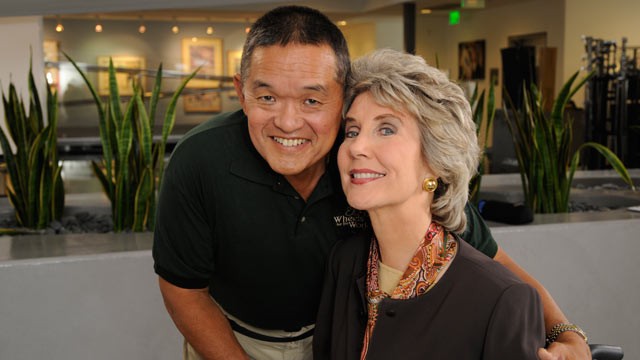
Deciding to Marry a Quadriplegic: Couple Tells Love Story

Ken Tada married Joni Eareckson in 1982 for better, for worse and for all the things that were uniquely her -- including the fact that she was a quadriplegic in a wheelchair.
The couple from Agoura Hill, Calif., now married 31 years, laughs that he had to change her leg bag on their first date at the movies, emptying the urine outside behind a tree.
"What goes in has to come out," said Ken Tada, 66 and a retired high school history teacher. "This part of the date had not been covered."
"People wondered: Here is an able bodied man and disabled woman. What is the attraction, why did they fall in love?" he said. "Those who know her know she has a beautiful heart and is beautiful on the outside. I fell in love with her."
Joni Eareckson Tada, now 63, was a successful disability rights activist, a painter and author of several books. She has been paralyzed since she was 17 and has no movement from her shoulders down, including the use of her hands.
"I was nervous when I met him," she said. "I had lived enough years as a single girl. I was traveling a great deal and enjoyed my freedom. No one had ever asked me out on a date."
Today, the couple chronicles their marital journey, including her battle with breast cancer and his with depression, in a memoir, "Joni & Ken: An Untold Love Story."

Only the details of her disability are unique to the Tadas. Theirs is a universal story about the power of faith and communication to strengthen any marriage.
The couple met at a local church during a "boring" sermon. As he tells it, she was sitting behind him, "praying through the back of my head."
"Through a series of coincidences, we kept running into each other and it sparked interesting conversations," he said. "I asked her out for a date."
At the time, he was working as a teacher and coach at a technical school.
"The kids couldn't figure out why I was working out so hard," he said. "But if I took her out, I had to do it myself, lift her in and out of the chair -- like curling 180 pounds." [Though, she hardly weighs that much, he added.]
She had been in a wheelchair since she broke her neck in a diving accident in Maryland when she was 17.
"I hit the bottom and crushed my spinal column," she said. "Years ago, rehab was not as refined as it is now. There was a lot of trial and error, but I am grateful I survived."
During rehabilitation, she learned to type and paint with a brush between her teeth.
"I am amazed what she can do," said her husband. "I thought talent came in the hands."

She began entering her art in local festivals and was interviewed by Barbara Walters in 1974. A publisher who saw her on the "Today Show" asked if she would write a book.
"I said, 'You bet,' and my writing burgeoned form there," she said.
That first book, "Joni," sold more than 4 million copies and was translated into 50 languages. That spawned her evangelical ministry to help others, Joni and Friends.
"I have been blessed with so much good health and a remarkable husband and opportunity to travel, that I want to pass the blessings on to the many millions of people with disabilities -- more than 1 billion in the world.," she said.
The couple dated for less than year before getting engaged.
"I was blown away with this good-looking guy who was strong and handsome and shared the same values and convictions as I," she said. "I readily said yes."

Friends had warned Ken Tada to try going away with her on a weekend first to see if it would work out. But he refused.
"Both of us believed that would not be honoring God," he said.
"There were a lot of unanswered questions on how this would work," she said. "We wanted to rely on God and our mutual core values to see us through the tough times."
After the first few years, the day-to-day caring was difficult for Ken Tada. He had to take off her make-up, and help with routine toileting and turning her in the bed at night because she couldn't do it for herself.
He taught during the day and did all the shopping after work.
"It was a 24/7 routine and we hadn't anticipated it would be so wearing," he said. "It was physically exhausting and mentally challenging."
At one point, he told his wife he "felt trapped" -- and then guilty for those feelings.
Communicating was a "freeing experience," according to the couple, and has continued to be a linchpin throughout their long marriage.

"My response was, 'If I were you, I'd feel exactly same way,'" she said. "'It's not your fault. ... I will be your support and stand with you to get through this.'"
"He was not the enemy, the wheelchair was not the enemy," she said. "The enemy was bigger than that and we were not going to start consuming each other with anger."
They agreed to get additional help.
Sometime in midlife, he was faced with depression.
"At some of the darkest times, if it wasn't for the fact that I believed in God, I wasn't sure I was going to make it," he said.
For the last three years, Joni Tada has been fighting stage 3 breast cancer and her husband has discovered new side of her:
"She is a real warrior and a fighter," he said.
As a result, the couple has grown closer. The couple credits the practice of "affirming one another."
"We strive to be open and honest with each other and solve problems by discussing them, rather than hiding and burying them," she said. "We pray and read the Bible together and I let my husband keep his dreams."
One of those dreams is fly-fishing, and she said she does all she can to encourage it.
"I am his cheerleader," she said.
As for him, "Joni is my biggest supporter," he said. "She is in my corner and my best friend. Not just fly fishing, but she always looks out for my interests and makes me love her that much more."
"I think I have the advantage," he said. "I married my best friend."
Disability has not stood in the way of their physical intimacy, she said -- "but we understand that there is more to romance than what happens below the waist."


Friday, May 24, 2013

Social media Tips for professionals

There has been an explosion in the use of new media over the last few years,  many professionals have asked their respective professional boards on how they should use it. Here is the general consensus, What ever your privacy settings, social media cannot be private; what you say stay there for an embarrassingly long time; an anonymity is an illusion- it is not difficult to track the source of comments.

Thursday, May 16, 2013

How to tell if a couple will get divorced


divorce
Think back to the last fight you had with your partner. Did you display any of these four behaviours? Picture: Thinkstock
IS it possible to predict whether or not a couple will get divorced?
Psychologists say yes.
Twenty years ago psychologist John Gottman and a team of researchers set out to determine why couples split up.
They recorded 80 married couples talking about a recent disagreement they'd had, the Scientific American reports.
Next the researchers coded the 15 minute conversations to identify all the behaviours the couples displayed when talking, such as defensiveness, anger or humour.
Fast forward 14 years. The researchers kept tabs on which couples were still together and which had divorced. And they noticed that there were four behaviours in particular that could predict which couples would divorce down the line. With 93 per cent accuracy.
1. Contempt
Couples who eventually divorced were twice as likely to express contempt during a disagreement than couples who stayed married. Contempt is described as much stronger than anger – it is anger mixed with disgust. For example talking to you partner like they are beneath you.
2. Criticism
Couples who criticised each other personally were also more likely to get divorced. The criticism went one step beyond complaining about a partner's behaviour to attack them about their personality.
3. Defensiveness
If one person played victim, did not take responsibility for their role in the conflict or tried to prove their partner was "more wrong" than them this was another sign the couple could be headed for divorce.
4. Stonewalling
If during an argument one or both partners switched off from the conversation it was a sign they were headed for divorce. But stonewalling goes beyond simply getting distracted, it often comes with physiological responses like sweating or a sped up heart rate and can be a sign a person is so stressed by a conflict that they just shut it out.
If you are thinking back to the last fight you had with your partner and you're a little worried, all hope is not lost. There are things you can do to deal with the problem behaviours in a healthy way.
Rather than criticise your partner personally, explain why their behaviour is upsetting you.
Instead of getting defensive take responsibility for your role in the conflict.
Build a "culture of appreciation" so partners treat each other with respect not contempt.
And if one person is stonewalling the other, work out if this is because they find the conversation too overwhelming. If so, work on taking deep breathes and calming down to make it easier to have an uncomfortable conversation.

Read more: http://www.news.com.au/lifestyle/relationships/how-to-tell-if-a-couple-will-get-divorced/story-fnet09p2-1226640299458#ixzz2TVoXEbNT

Wednesday, May 8, 2013

How to make your Marriage last

'All You Need is Love' may be one of the greatest songs written by the Beatles, but the premise is scientifically invalid, according to a study in the latest edition of Monitor on Psychology.
Work hard: People who stay married for a long time make a conscious effort at working at their relationships. They place their commitment to each other as a higher priority than work, hobbies and even their children. They know the best way to be a great parent is to be in a loving and long-lasting relationship.
Talk about things that matter: It's so easy to waste time talking about routine matters of work, family or chores. Happy couples talk about their dreams, fears, hopes and fantasies. They share very private and personal feelings and thus stay emotionally engaged with their partner. With a psychological security based on trust and communication, these couples can truly be themselves and experience that amazing feeling of being safe and accepted in another's presence.
Be nice: We all want to feel special, particularly from our lifelong partner. The experts have found that little things mean a lot in a relationship. Simple things such as a genuine compliment, a thoughtful surprise and special attention during tough times really matter. They reflect a caring and concern that mean a lot more than flowers once a year.
Celebrate life: A colleague left work early to take her husband out for dinner to celebrate his recent positive evaluation at work. I voiced some surprise at making such a big deal over such a routine event. My friend gently advised me that their family constantly searches out opportunities to notice and enjoy events that others may view as routine. Successful partners enjoy each other and they actively look for ways to have fun. They are attentive to the small accomplishments of their partners.
Advertisement
Argue gently: Conflict is inevitable in any relationship. Arguments about making, saving and spending money are the No. 1 sources of tension between partners. Good couples don't ignore such problems, but deal with them in a respectful way with lots of compromise and communication. They avoid bringing up past hurts but focus on coming up with acceptable solutions for both partners.
Fight boredom: So much of how we live our lives is due to routine and habit. After a while, it is natural to get bored by your partner and seek excitement elsewhere. Committed couples avoid that malaise by taking risks and trying new activities. This adds a vitality and excitement to your relationship and makes it more enjoyable to be around your partner.
All You Need is Love may be one of the greatest songs written by the Beatles, but the premise is scientifically invalid, according to a study in the latest edition of Monitor on Psychology. In fact you need quite a bit more than just the love stuff, with one in three Australian marriages ending in divorce. Here's some tips on how to beat those statistics, according to experts who have studied wedded unions that have lasted.
The message from the marriage experts is clear: Work hard, be nice, celebrate life, take chances and don't listen to the Beatles.

Gregory Ramey