The Science of Dating: why we should stop dating online
In a weekly blog, Sarah Knapton, the Telegraph's Science
Correspondent, delves in to the science of attraction, sexuality,
relationships and dating. This week, online dating
Dating in the 21st century is pretty bleak. It's so bleak that we
are increasingly throwing ourselves at the mercy of computers,
outsourcing our love lives to algorithms and spreadsheets.
Marketing and the film industry tells us that 'Planet Single' is a
barren, isolated wasteland where it rains the silent tears of the
broken-hearted. Escape from this planet is mandatory.
But for most single people I know life is pretty good. Being on the
shelf is only a problem if your shelf is dull. In fact, the older you
get, the more interesting your shelf is likely to become and the harder
it is to be coaxed off.
And we are extending our own shelf-life everyday by staying fitter,
healthier and more attractive for longer. Women are no longer crying
into their Chardonnay. Singles are more likely to be playing capoeira;
dining at secret supper clubs; running with the Good Gym or digging up
their home-grown kale.
Which is why dating is such a problem. Why would you want to spend
an excruciating hour getting to know a complete stranger when you could
be enjoying ukulele karaoke with your mates or learning to make gin?
So it's not surprising that we have turned to internet dating to
help speed up the process, screening out the undesirables with a tap of
the delete key.
Today in Britain one in five heterosexual couples met online and a
whopping 70 per cent of homosexual couples found their partner via the
web.
But wait! New research is suggesting there could be very real
problems with internet dating. Michigan State University found that
married couples who met online are three times more likely to divorce
than those who met face to face.
And online daters are 28 per cent more likely to split from their partners within the first year.
Even the CEO of Match admits that online dating cycles are shorter
because people are more willing to leave unsatisfying relationships.
It's easier to throw in the towel when you know there are 20 more towels
waiting to be picked up.
"There is a greediness involved in online dating," says Ayesha Vardag, one of Britain's leading divorce lawyers.
"It is, after all, a sort of digital menu full of people waiting to
be chosen or disregarded. As well as the convenience factor it's easy to
get carried away with the high of instant gratification and not give
the relationship a real chance to develop."
Paradoxically, by opening up a new world of choice, we have become
aware that there could always been someone better just a click away.
In that way, sexual attraction is similar to hunger.
"And who has not found their appetite suddenly revived when a new
course is presented?" writes Professor Frederick Toates in his new book
'How Sexual Desire Works.'
The US Association of Psychological Science also found that browsing
multiple profiles makes people far more judgemental that they would be
in a face-to-face meeting, quickly writing off candidates who don't tick
every box.
And the chances of opposites attracting? Forget it online. You'll
only get matched with people who like the same films as you, read the
same newspaper, like dogs, go to church. In other words you are looking
for a clone. And in biological terms that doesn't end well.
In fact, the most compatible partner genetically would be the one
who is the least like you. In Dan Davis's recent book 'The Compatibility
Gene' he surmises that a spouse whose immune system is completely
different to your own is likely to make the best life partner.
In terms of evolutionary biology it is easy to see the benefit of
having one partner who is less susceptible to getting colds or flu while
another has greater immunity to measles.
But how does this translate into dating? If you catch eyes with a
stranger in a bar you can't look into their genome and rate your
compatibility.
Yet there is increasing evidence that, in face-to-face meetings, the
body is subconsciously picking up clues about the suitability of future
partners based on their DNA and our own.
Face shape, height, body size, skin tone, hair quality and even
smell are all indicators on whether the person we just met would be good
to mate with. We emit pheromones which give valuable clues about our
genetic compatibility to someone else.
"Sexual desire arises from a combination of sensory stimuli, visual,
smell, sound and touch, acting on the brain at both a raw level and a
context of memories to which they are associated," points out Toates.
And that can't be recreated by viewing a computer profile.
To put it another way, meeting someone we fancy sparks a whole
cascade of biological triggers. After all, dating is mating. And mating
is governed by millions of years of evolution. So it's surely better to
work with that than against it. By relying on dating profiles we may be
writing off dozens of individuals who would be suitable, while wasting
time on those that aren't.
This blog will be about getting out there and finding out the best
ways of interacting with people face-to-face rather than through a
screen.
As a friend pointed out to me recently: "How are you ever going to meet anyone, if you are not actually meeting anyone?"
We don’t commit now. We don’t see the point. They’ve always said
there are so many fish in the sea, but never before has that sea of fish
been right at our fingertips on OkCupid, Tinder, Grindr, Dattch, take
your pick. We can order up a human being in the same way we can order up
pad thai on Seamless. We think intimacy lies in a perfectly-executed
string of emoji. We think effort is a “good morning” text. We say
romance is dead, because maybe it is, but maybe we just need to reinvent
it. Maybe romance in our modern age is putting the phone down long
enough to look in each other’s eyes at dinner. Maybe romance is deleting
Tinder off your phone after an incredible first date with someone.
Maybe romance is still there, we just don’t know what it looks like now.
When
we choose—if we commit—we are still one eye wandering at the options.
We want the beautiful cut of filet mignon, but we’re too busy eyeing the
mediocre buffet, because choice. Because choice. Our choices are
killing us. We think choice means something. We think opportunity is
good. We think the more chances we have, the better. But, it makes
everything watered-down. Never mind actually feeling satisfied, we don’t
even understand what satisfaction looks like, sounds like, feels like.
We’re one foot out the door, because outside that door is more, more,
more. We don’t see who’s right in front of our eyes asking to be loved,
because no one is asking to be loved. We long for something that we
still want to believe exists. Yet, we are looking for the next thrill,
the next jolt of excitement, the next instant gratification.
We soothe ourselves and distract ourselves and, if we can’t even face
the demons inside our own brain, how can we be expected to stick
something out, to love someone even when it’s not easy to love them? We
bail. We leave. We see a limitless world in a way that no generation
before us has seen. We can open up a new tab, look at pictures of
Portugal, pull out a Visa, and book a plane ticket. We don’t do this,
but we can. The point is that we know we can, even if we don’t have the
resources to do so. There are always other tantalizing options. Open up
Instagram and see the lives of others, the life we could have. See the
places we’re not traveling to. See the lives we’re not living. See the
people we’re not dating. We bombard ourselves with stimuli, input,
input, input, and we wonder why we’re miserable. We wonder why we’re
dissatisfied. We wonder why nothing lasts and everything feels a little
hopeless. Because, we have no idea how to see our lives for what they
are, instead of what they aren’t.
And,
even if we find it. Say we find that person we love who loves us.
Commitment. Intimacy. “I love you.” We do it. We find it. Then, quickly,
we live it for others. We tell people we’re in a relationship on
Facebook. We throw our pictures up on Instagram. We become a “we.” We
make it seem shiny and perfect because what we choose to share is the
highlight reel. We don’t share the 3am fights, the reddened eyes, the
tear-stained bedsheets. We don’t write status updates about how their
love for us shines a light on where we don’t love ourselves. We don’t
tweet 140 characters of sadness when we’re having the kinds of
conversations that can make or break the future of our love. This is not
what we share. Shiny picture. Happy couple. Love is perfect.
Then, we see these other happy, shiny couples and we compare. We are
The Emoji Generation. Choice Culture. The Comparison Generation.
Measuring up. Good enough. The best. Never before have we had such an
incredible cornucopia of markers for what it looks like to live the Best
Life Possible. We input, input, input and soon find ourselves in
despair. We’ll never be good enough, because what we’re trying to
measure up to just does not fucking exist. These lives do not exist.
These relationships do not exist. Yet, we can’t believe it. We see it
with our own eyes. And, we want it. And, we will make ourselves
miserable until we get it.
So, we break up. We break up because we’re not good enough, our lives
aren’t good enough, our relationship isn’t good enough. We swipe,
swipe, swipe, just a bit more on Tinder. We order someone up to our door
just like a pizza. And, the cycle starts again. Emoji. “Good morning”
text. Intimacy. Put down the phone. Couple selfie. Shiny, happy couple.
Compare. Compare. Compare. The inevitable creeping in of latent, subtle
dissatisfaction. The fights. “Something is wrong, but I don’t know what
it is.” “This isn’t working.” “I need something more.” And, we break up.
Another love lost. Another graveyard of shiny, happy couple selfies.
On to the next. Searching for the elusive more. The next fix. The
next gratification. The next quick hit. Living our lives in 140
characters, 5 second snaps, frozen filtered images, four minute movies,
attention here, attention there. More as an illusion. We worry about
settling, all the while making ourselves suffer thinking that anything
less than the shiny, happy filtered life we’ve been accustomed to is
settling. What is settling? We don’t know, but we fucking don’t want it.
If it’s not perfect, it’s settling. If it’s not glittery filtered love,
settling. If it’s not Pinterest-worthy, settling.
We realize that this more we want is a lie. We want phone calls. We
want to see a face we love absent of the blue dim of a phone screen. We
want slowness. We want simplicity. We want a life that does not need the
validation of likes, favorites, comments, upvotes. We may not know yet
that we want this, but we do. We want connection, true connection. We
want a love that builds, not a love that gets discarded for the next
hit. We want to come home to people. We want to lay down our heads at
the end of our lives and know we lived well, we lived the fuck out of
our lives. This is what we want even if we don’t know it yet.
Yet, this is not how we date now. This is not how we love now.
Spaniard wants to be ‘back where I was’ and, revealingly, says injuries ‘make tennis tough … but at the same time beautiful’
An hour in the company of Rafael Nadal
on a still, Wimbledon evening dispels the notion of a wounded champion
in crisis. If anything, the Spaniard, who has tumbled to 10th in the
world shortly after his 29th birthday and is lightly regarded among many
observers as a genuine threat to unseat Novak Djokovic here, appears to
have left the battle smoke of Paris behind him with more equanimity
than anyone could have imagined.
Still, it has been a minor nightmare of a summer for Nadal,
pre-eminent on clay yet losing five times on the European dirt, with
Djokovic rubbing it in at Roland Garros in the quarter-finals. Does
going through this sort of a slump renew his hunger or feed his anxiety,
I wondered? “I have the best motivation: to be back where I was. And
I’m gonna work for it.”
He will, of course. Nadal’s career, even at its peak, has been about
struggle, intensity, sweat – as opposed to the player alongside whom he
has driven towards greatness, Roger Federer. The Swiss, in stark
contrast, arrives here lightly and smiling at 33, with all the twins in
tow, to make another quiet raid on his favourite tournament.
During a break in the US Open a few years ago, American television
showed slow-motion clips of just the feet of Nadal and Federer as they
moved side to side along the baseline. Nadal, almost defying the slo-mo,
was the quick-stepping boxer, all tightly sprung energy; the Swiss was a
ballet dancer, the very picture of floating, effortless menace. Nadal
seems to have to fight like that boxer every day; Federer is forced from
his choreographed elegance only in extremis.
As William Skidelsky observes in his eccentric, engaging love letter to Nadal’s Swiss opposite, Federer and Me: a Story of Obsession:
“The Spaniard is sometimes compared to a capybara, the buck-toothed
South American rodent but, while it’s true that there’s a striking
visual resemblance, strategically he’s more of a boa constrictor:
instead of swiftly dispatching his victims, he subjects them to a
drawn-out asphyxiation.”
Apart from the cruel metaphor, it is a notion with which Nadal would not violently disagree.
“Everybody is different, yes,” he says. “I’m not sure about the word
‘talent’, because everything is a talent. He has a different talent to
me.
“It is obvious that he hits the ball easier than me, he serves better
than me and he is able to do the things easier than what I do. So his
talent is much better there.
“But I have talent too – to be there. I have the talent to put one
more ball inside. I have the talent to play with a good level a lot of
hours in a row. That is what I did during my whole career. And I have
the talent to not miss much, and to come back from very tough positions,
to be in a defensive position and pass very quickly to an aggressive
position. His style is completely different to mine. Probably that makes
the rivalry special.”
The only point at which they could engage for a 34th time would be in
the semi-finals. It is unlikely, and a blow for nostalgics. If they do
meet, it will be business not sentiment that informs their work. They
are, as Andy Murray has said of his relationship with Djokovic,
“professional friends”. And Nadal had not heard of Federer’s sceptical
response last week to Boris Becker’s claim in his latest book that the
leading players pretend too much to like each other, a feeling the
German regarded as implausible.
“I had not read that. My point of view is that what happens outside
the court isn’t going to have a big impact on what’s going to happen on
court.
“But it is difficult to be very good friends, because at the end of
the day, the best friends are the ones who know you since you were a
kid. They are my real friends. At the same time, it is good to respect
everyone, to have a good relationship, even if you are not best friends.
“For me it is important to have a good relationship with the people
you are going to be with every week on the Tour. It’s a bad feeling if
you go in the locker room, look around you and you don’t have a good
relationship with them. A lot of people, they see maybe another point of
view: more drastic, more dramatic, that everybody is a rival. For me,
tennis is very important but not the most important thing in life.”
On his return to Wimbledon,
taking in the glorious greenness of it all, the mere playing of tennis,
a sport he loves and is so good at, surely must seem like the best job
in the world. Yet with glory and fame has come angst and suffering, the
baggage of defeat and serial injury. With 14 majors in the bag and
enough money to last several lifetimes, is it still worth it?
“You compete every day. A lot of players on Tour have injuries, so
that makes the sport tough … but at the same time beautiful.” This is
warrior language. Nadal, perhaps in a Catholic way, embraces pain as the
price for his gifts. Federer, meanwhile, has not had pain as a constant
travelling companion. He has had the freedom to be an artist.
“There are tougher things in life,” Nadal says of his calling, “and everybody on the ATP Tour knows we are very lucky people.”
When a Madrid specialist told the Spanish teenager in 2004 that he
had a deformed tarsal scaphoid bone on the bridge of his left foot and
that he might never play again, he was shattered to the point of
breakdown, according to his autobiography: “I’d lie for hours on the end
on the sofa staring into space, or sit in the bathroom or on the
stairs, weeping. I didn’t laugh, I didn’t smile, I didn’t want to talk.
I lost all appetite for life.”
That image of despair is hard to equate with the atomic energy he
still brings to the court. He has done so over the years, however, with a
built-up shoe that checked the original foot problem, transferring it
to his knees, wrists and elbows and building a dark forest of vulnerable
places in his muscled body, like the ones Federer finds when placing
his spots on serve against him, shifting the point of doubt and hurt.
“I had the past couple of years some dark periods of time [six months
away from playing with a wrist injury, then an appendectomy]. People
talk a lot about injuries in my career but from 2005 to 2011, the
injuries that I had didn’t stop me for enough time to go out from the
top positions of the rankings, so I feel good about that. Some players
get more injuries than others. That’s part of our life. Some players are
not lucky with that, lucky with other things. I had some bad moments, a
lot of very good moments. If you put everything in balance, much more
positive than bad. I am fine now.”
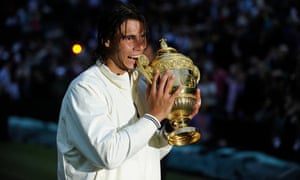
Wimbledon 2008: Rafael Nadal with the Wimbledon men’s singles trophy
after defeating Roger Federer in an epic match. Photograph: Tom Jenkins
for the Guardian
For someone with a lucrative watch sponsorship, Nadal and time don’t
always click. (This is our fourth attempt to talk in three months.
Defeat in Monte Carlo nixed the first one. Then there was Paris, ditto
but worse. And Queen’s …) But he is fiercely devoted to his training
schedule and arrives on the players’ terrace glowing from another
encouraging workout on the practice courts, accommodating but focused.
He had arrived in London from Mallorca midweek and headed straight
for the shops to stock up for the fortnight in his rented house. Anyone
who spotted a former two-times champion at the All England Club roaming
the shelves for cornflakes in Wimbledon that day might have thought they
had walked in on a photoshoot, but Nadal likes to stay rooted. It has
kept him humble, which is not easy if you’ve earned $73m in prize money
over 14 years, alongside endorsements and other deals that placed him
22nd on the Forbes Magazine list of the world’s best paid athletes in
the year ending this month.
One detailed breakdown of his career earnings puts his net worth at about $125m.
Addressing that privilege, Nadal has had a foundation for eight years, inspired by his mother, Ana María.
“When I was a kid, my mam was always great helping people. I saw when
I was young she was always to send money to different places for the
kids. Talking with her, we decided to create a foundation.”
They began in Anantapur in India, among the dalits, or
untouchables, and spread later to Barcelona, Zaragoza and Andalucía. “We
aren’t going to change much but if all the people who have a lucky,
privileged life can help a little bit then that is a lot of help. My
foundation tries to help kids at risk of exclusion from society.”
Now he is taking the project home to Mallorca. “I feel very lucky all
the things that I have, all the things that happen to me. So it’s just a
small way to give back something. It’s a big project for me, with 25
tennis courts and places for the kids to live, with a school too, and a
big gym, small football stadium, different sports, some indoor courts.
It’s something that’s going to be part of my future, a lot of work. But I
have the motivation. I love sport in general … And I love tennis.”
Did he never get tired of tennis? He did say at the O2 finals in 2011 – not one of his easiest campaigns – that he had “lost the passion” for it …
“That was a good but at the same time a very tough season. I lost a
lot of finals. I lost the final in Indian Wells, I lost the final in
Miami, I lost the final in Madrid, I lost the final in Rome, I won
Roland Garros, but I lost the final here, I lost the final of the US
Open. So, yes, you’re right. At the end of the season, you lose a little
bit intensity, you lose a little bit of passion for the game. But,
mentally, I got it back. I played Davis Cup in Spain. We won the final –
and I started 2012 very well.”
So, was winning the spur to carrying on? “What drives me every day is
the work. It is important to achieve goals, even if they are not big
goals. You have to achieve the small objectives too. Winning? … In sport
the victory is … ”
Everything? “Ha! No, not everything. But it’s very, very important.
People only remember the victories. Our sport is not a sport of losses.
You can lose hundreds of times, but the people only gonna remember the
victories.”
But in some ways those who don’t win all the time do not have that
pressure, no? He pauses. The right eyebrow goes north in sync with his
closed mouth, as if dragged upward in wonder.
“It is obvious that the pressure for the top players to win almost
every single match is completely different for the players a little bit
lower ranked. But, at the end of the day, everybody wants to win. Every
match is very competitive.”
Yet losing to Nick Kyrgios here in the fourth round last year must
have left at least a small psychic bruise. Nadal remembers it as he
remembers beating Federer the first time they met, in Miami in 2004 –
and the young Spanish kid won.
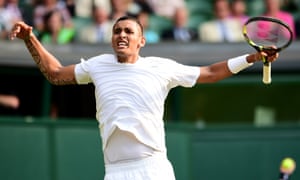
Australia’s Nick Kyrgios celebrates winning a game against Rafael Nadal
during their fourth round match at Wimbledon 2014. Photograph: Carl
Court/AFP/Getty Images
“Everything is a little bit easier when you are a kid. But all the
moments of your career have that beautiful thing: your mentality
changes. It is important to adapt your tennis, your mental condition, to
those different moments.”
What is it like, then, going out to play these other great players,
week after week: there he is again, that pesky Djokovic? Is there not a
history that builds up?
“Yes, but at the same time … every moment in the year is different,
every moment in your career is different. Every match depends on how
[each player] arrives at that match.”
How did he cope with losing in Paris, then?
“It was less tough than in 2009 [when his parents separated and his
tennis lurched this way and that]. I know that can happen – and it
happened. I competed for one hour and 30 [minutes], and that is not
enough to win against Novak. This season there have been more ups and
downs, but the last couple of months I am playing better. And I intend
to continue like this.
“It is not easy: six months, nearly, without playing tennis last
year, injury. I lost a few matches this year that I shouldn’t have. When
that happens a few times, it affects your confidence. When you come
back from injury, it is important to win those matches that you can win
or lose, to bring your confidence again and to feel that you are strong
again.”
He runs through all his losses, in details with scores, and sighs as
he says, “So there were a lot of matches that I should win: one week ago
[against Alexandr Dolgopolov in the first round at Queen’s] 4-3 and
serving with break in the first … If you are able to win these matches,
the year changes and you have the chances to be in a better position in
the ranking. You accept that, and when you change that, you are there
again.”
So, can Wimbledon, the place of some of his finest hours and lowest moments, inspire him to halt the slide?
“On grass, every match is dangerous, every player is dangerous. If
you play well, if you find the real rhythm, you can have a lot of fun.
It is a feeling I have had a few years here in my career. It is very
special. Obviously it is more difficult not being seeded top four. I am
seed 10 because I didn’t play well enough and because I was out injured
for six months last year. I am where I deserve to be now, and I hoped to
be in a higher position back here. I am going to work for that, but
what gonna happen gonna happen. I need to do it my way.”
From a recent interview, Bob Brett
shared 5 characteristics of a champion. It's safe to say Bob Brett is a
humble spirit who possesses a wealth of experience from working with
world class players on the tour. His notable players include Becker,
Ivanisevic, Medvedev, Ancic, and Cilic. The most impressive quality about Bob is the length of time he worked with each player.
Here are the 5 qualities of a champion according to Bob Brett:
1) World class talent. The ability to learn. The ability to see the court. Intuitive skills.
2) Play one's best when it counts the most.
3) Be able to push one's self to do the right thing.
How strong is one's character to do the things one does not want or
like to do. Do the right thing with one's behavior, training, and to
stay disciplined.
4) To overcome difficulty. It could be injury, confidence, keeping one's mind through it all.
5) Loyalty to what you want to do.
Believe what you are doing is the right thing and what you want to do.
Choosing the right people to work with and trusting them, not turning
to someone else when difficulty comes. Disruptions in coaching break
develop and one should be cautious of such changes. The best players
had very few coaches.
After reading through the list, let's discuss each point in how it relates to junior/college players.
1) World class talent- yes, one could
argue each player is born with it or not. However, if one has a high
ability to learn (love for the game) and willing to put in the time
(10,000 hours), they can reach their own potential. Most juniors/college players do not have the ability to LEARN HOW TO LEARN.
Without love or thirst for learning (just give up!), tennis is too
hard. To the PARENTS- just give up and stop fighting a losing battle if
your dreams are to make your child something he isn't (big time D1
scholarship or world class player).
2) Play one's best when it counts the
most- This one you can't teach, but it can be helped along by putting
kids into pressure situations more often. This includes dominating your
own age division before moving up, not ducking tournaments, playing all
the tournaments regardless if you are #1 seed, playing atleast 8-10
practice sets a week against people at your OWN LEVEL, and not
substituting lessons for matchplay. Have to practice being in pressure
situations. Non-PRESSURE situations include jetting around the
world playing ITFs, chasing points at National Junior Events, playing
Professional events, ducking Nationals after you signed with a college,
taking lessons over matchplay, etc.
3) Be able to push one's self to do the
right thing- This comes down to character and usually the guidance and
parenting a child receives. Be honest, don't cheat, be
self-motivated...all qualities of someone of high character. Children look to copy their role models (other good players, so beware if they are acting like idiots), parents, and coaches.
4) To overcome difficulty- again, this
is a character issue. The parents can help foster a child to respond to
difficulty in an encouraging way.
5) Loyalty- again, not looking to place
the blame on others but yourself if things don't go your way. Starts
with the parents again.
Notice how Bob Brett didn't talk about forehands, backhands, serves, and spin ratio on the slice backhand (that ain't it!). Enjoy!
Nadal indicated that this year's exit to top seed Novak
Djokovic was more easily accepted than his 2009 defeat in the fourth
round to Robin Soderling, when he was affected by family problems and a
knee injury.
"I was not happy," he said, "But at the same time... you know, 2009 I
did the right things before Roland Garros. This year I didn't make the
right things before Roland Garros so was not surprised. There is another
player who was playing better than me in that moment."
Last week, Nadal switched to grass and win Stuttgart. "I have the
motivation to be back to my best. After what happened in Roland Garros,
have the chance to win the title the week after is very good news for
me," he said.
Nadal is now looking to be consistent to set himself up for 2016. "My
main goal is finish the season healthy," the Spaniard said, "Have the
chance to play the full season. I am confident that I can play, I gonna
have a much better second half of the season."
He insists that capturing another Grand Slam title is not what he is
concentrating on at the moment. "[The] first goal is to be in the World
Tour Finals," Nadal said. "Winning Grand Slams or not, I won enough into
my career. Fourteen are enough. I am sure that I gonna keep trying my
best."
Despite everything, Nadal noted he is still among the world's best
players. Ranked No. 4 at the beginning of the season, he fell to No. 10
following the French Open, but now has fewer points to defend the rest
of the year.
"If I am able to be at No. 10 in the world playing that bad, you know,
if I am able to play a little bit better I will be higher," he said.
Rafael Nadal,
who won his first grass-court title at Queen’s in 2008, went out in the
first round on Tuesday after an absence of four years but said the
defeat had not dented his self‑belief for Wimbledon, which starts on
Monday week.
“It’s a loss, I think I didn’t play bad at all,” he said after losing
to the world No79 Alexandr Dolgopolov, who powered 16 aces past the
Spaniard to win 6-3, 6-7, 6-4 in two hours and 13 minutes in front of an
audience that included José Mourinho and the former king of Spain, Juan
Carlos.
Nadal, who lost to Novak Djokovic in the quarter‑finals of the French
Open two weeks ago and has endured a difficult summer on his favoured
clay surface, stormed back to form in Stuttgart last Sunday to win his
first grass-court tournament in five years.
“I fought until the end,” he said. “He played well and he was a
little bit better than me but I cannot say I am very sad the way that I
played. [There is] nothing very negative, [after] winning a tournament
last week.
“This week I lost an opportunity but my feeling, my thoughts, are no
different today than yesterday. I am playing better than before and
enjoying my tennis more on court than before. I will keep going, keep
practising hard. I hope to be ready to play well at Wimbledon.”
He said the presence of Juan Carlos and Mourinho – both of whom he
knows well – did not disturb his focus. “I have a great relationship
with the king. I have a very good relationship with José, too. It is
good to have the support of the crowd, but it’s not an inspiration, not
an extra pressure. I play my game. I try to do my best in every single
match of the year and not try to be better if there is somebody or not
on the crowd.”
Advertisement
Nadal
deflected a suggestion that Mourinho might have been in a position to
give him advice. “He’s a football manager. He’s one of the best of the
world. And I have my team. I will never give him advice on football and
probably he will not be giving me advice on tennis.”
Having complained of nerves and self-doubt during four defeats on
European clay before Roland Garros, Nadal does look rejuvenated. It was
his misfortune to strike Dolgopolov on one of his best days. “He’s
difficult on every surface and his serve today was great, huge. His
second serve was so difficult to read, too, because sometimes he played
with bigger slice, and sometimes he played with topspin. So it was not
easy.” Dolgopolov plays Guillermo
From the beginning of human existence to the discovery of electricity
and the creation of light bulbs, humans only exposed to only natural
light and no electronic devices, had
their circadian clocks synchronized with the rise and fall of the sun.
This is how we were created. However, with the advancement of
technology and the 24/7 society, we are now altering this nature cycle
and this could lead to detrimental consequence to our physical and
mental health.
From the very early human existence, the
light from the sun tells our body that it is day time. This is achieved
by the suppression of the body clock hormone secreted in the pineal
gland in our head. The humans then go out to hunt and gather. They then
return home when sun is setting and the reduction of the sun light
allows the pineal gland to secrete Melatonin which makes us feel sleepy.
It is the nature's way of tell us, it is time to go to bed and get
rest.
Unfortunately the pervasive glow of
electronic devices at night time is disrupting our circadian cycle. The
lights from
the electronic devices such as computer screens, smartphones and tablets
often stay on throughout
the night. These devices emit light of all colors but it is the blue
spectrum light that suppresses our melatonin production and tricks our
brain and body that it is day time. As a result we are
systematically
sleep-deprived because of how society works against our natural
clocks. Studies has shown sleep deprivation increases the risk of mood
disorders such as depression and anxiety and reduces our ability to cope
with stress.
Our modern society also encourages children starring at the electronic device screen all night. The danger with disturbing children's sleep can affect their brain development. Sleep is important for learning, memory, brain development, health. We’re systematically sleep-depriving kids when their brains are still developing, and we couldn’t design a worse system for learning.
Many epidemiology studies aslo demonstrated that shift workers have higher
incidence of cancers eg ( breast, colon, prostate cancers). It has
been suggested that the disruption of our body biological clock weaken
the immune system. Previous animal studies showed that disruption
of the biological clock can lead to accelerated neurodegeneration, loss
of motor function and premature death.
This is an
important issue that people don't talk about because our society is so
addicted to 24/7 lifestyle, profit driven society that bombarded us with
more electronic gadgets which will result in unintended consequence in
the human evolution .
During the new year break, we had the chance to review our dancing videos. I was speechless when I saw my 2014 competition videos. The improvement was more than what I would expect. Everyone from the studio and our competitors are all commenting on this.
I had the chance to dig out old videos of my former dance teacher Aksel Davis from North Carolina. I am sure he would be proud that my current skills are equal or better than his previous performance. I also had the chance to watch the ballroom addict Cloud Cray's video and I showed these videos to my teachers and they now confirmed with us that we are as good if not even better.
It has been a long journey with ballroom dancing. I was never interested in dancing until my good friends tried to irritate me by giving me free dancing lesson voucher as a birthday present in 2010 before I went to USA for my Neurotology skull base surgery fellowship. I went for the lesson to avoid wasting the birthday gift and not because I wanted to learn. I told the teacher that I wanted to learn Argentine Tango. She asked me why ? I thought I lived in Argentina for 6 months when I was 6 and that was the dance that I could remember seeing. So she taught me the dance but then started teaching me Latin dances eg Cha-cha , Rumba then Salsa. She told me that I have talent. I thought she was just saying that so she could get me to have more lessons with her. Then I started to get better and did enjoy her private lessons. I told her that I could not continue as I was heading to USA for 2 years. She insisted me to find a teacher to continue to learn dancing. When I came to Chapel Hill North Carolina, I attempted to find a dance studio but because I had no car there was no studios within walking distance. I googled latin dancing and UNC and discovered the UNC ballroom dancing team. I emailed Caroline Gott as she was the contact detail person. She then introduced me to Ellen Porter who was the captain of the team. She recommend Aksel Davis who was the number 1 amateur ballroom dancer in NC. I had lessons with Aksel and he taught me all the Latin dances. Then he started to teach me Waltz, Quick step , Tango and Foxtrot. I had never heard and seen those dances before but I still learned the dances because Aksel was a great teacher.
I was never interested in competing as I learned dances just for fun and tried something that I hated previously and challenged myself. After the Summer break, Captain Ellen contacted me and checked my progress with Aksel. She then convinced me to join the UNC ballroom team and have group lessons with the team. I was still not interested in competing but Aksel and Ellen were very persistent. Then my first ever competition dance partner, Madison Mandy , asked me to compete with her. As there were fewer male dancers, I felt bad if I said no to her. So I did my first ever ballrom room competition. I think it was the DCDI. That was how I started with competitive ballroom dancing. While I was in USA, I was doing much better in Latin dances then Standard dances. There are few reasons behind this. Madison is tall so it was not an easy match in terms of height for standard dances. However, we did well in the competition. We did better in Latin because equal heights between the couple looked fine. Furthermore, Madison has a lot of dancing background and she is tall, slim and very pretty and this always give her extra points on the competition floor. I think this helped a lot in the early round as we got noticed early. I might be wrong.
However, the real improvement or the quantum leap actually started after I came back to Australia and took up lessons with Shane Hocking and Kym Smith. They were 10 times undefeated Australian national ballroom dancing champions. They had 20 years of teaching experience after their retirement from competitive dancing and produced top 10 ballroom dancing couples including several top 10 internal ranked ballroom dancers consistently. Ballroom dancing made more sense after I came back to Australia. Once we dropped Latin dances and focused just on Standard dances , we saw this quantum leap in our improvement and skill level.
Hopefully, we will continue to improve at this quantum leap pace in 2015.
Lastly, it has been 6 months since I removed myself from facebook and social media. For those who doubted that this could be done, I say " yes you can." Life is normal without social media. Without social media, my focus on the presence and on my work, career, family and building a closer bonds with friends are benefiting greatly. I called my love ones, friends directly and visited them in person. If they are overseas, I write individual person email to stay in contact. I think my friends appreciated this more as we share news in person and it is more human and less technical and robotic.
One of my good friends from UNC , Monica Heister , wrote a very touchy email. She said "You have inspired and encouraged me in many ways - you are a blessing! ". I tried to stay in touch with Monica and many others and share stories and give my support as a friend from far away. She was very touched because no matter how busy I was, I would always find a time to reply their message and to drop a line to check how my close friends are progressing in their life and provide support in any way I can.