
An hour in the company of Rafael Nadal on a still, Wimbledon evening dispels the notion of a wounded champion in crisis. If anything, the Spaniard, who has tumbled to 10th in the world shortly after his 29th birthday and is lightly regarded among many observers as a genuine threat to unseat Novak Djokovic here, appears to have left the battle smoke of Paris behind him with more equanimity than anyone could have imagined.
Still, it has been a minor nightmare of a summer for Nadal, pre-eminent on clay yet losing five times on the European dirt, with Djokovic rubbing it in at Roland Garros in the quarter-finals. Does going through this sort of a slump renew his hunger or feed his anxiety, I wondered? “I have the best motivation: to be back where I was. And I’m gonna work for it.”
He will, of course. Nadal’s career, even at its peak, has been about struggle, intensity, sweat – as opposed to the player alongside whom he has driven towards greatness, Roger Federer. The Swiss, in stark contrast, arrives here lightly and smiling at 33, with all the twins in tow, to make another quiet raid on his favourite tournament.
During a break in the US Open a few years ago, American television showed slow-motion clips of just the feet of Nadal and Federer as they moved side to side along the baseline. Nadal, almost defying the slo-mo, was the quick-stepping boxer, all tightly sprung energy; the Swiss was a ballet dancer, the very picture of floating, effortless menace. Nadal seems to have to fight like that boxer every day; Federer is forced from his choreographed elegance only in extremis.
As William Skidelsky observes in his eccentric, engaging love letter to Nadal’s Swiss opposite, Federer and Me: a Story of Obsession: “The Spaniard is sometimes compared to a capybara, the buck-toothed South American rodent but, while it’s true that there’s a striking visual resemblance, strategically he’s more of a boa constrictor: instead of swiftly dispatching his victims, he subjects them to a drawn-out asphyxiation.”
Apart from the cruel metaphor, it is a notion with which Nadal would not violently disagree.
“Everybody is different, yes,” he says. “I’m not sure about the word ‘talent’, because everything is a talent. He has a different talent to me.
“It is obvious that he hits the ball easier than me, he serves better than me and he is able to do the things easier than what I do. So his talent is much better there.
“But I have talent too – to be there. I have the talent to put one more ball inside. I have the talent to play with a good level a lot of hours in a row. That is what I did during my whole career. And I have the talent to not miss much, and to come back from very tough positions, to be in a defensive position and pass very quickly to an aggressive position. His style is completely different to mine. Probably that makes the rivalry special.”
The only point at which they could engage for a 34th time would be in the semi-finals. It is unlikely, and a blow for nostalgics. If they do meet, it will be business not sentiment that informs their work. They are, as Andy Murray has said of his relationship with Djokovic, “professional friends”. And Nadal had not heard of Federer’s sceptical response last week to Boris Becker’s claim in his latest book that the leading players pretend too much to like each other, a feeling the German regarded as implausible.
“I had not read that. My point of view is that what happens outside the court isn’t going to have a big impact on what’s going to happen on court.
“But it is difficult to be very good friends, because at the end of the day, the best friends are the ones who know you since you were a kid. They are my real friends. At the same time, it is good to respect everyone, to have a good relationship, even if you are not best friends.
“For me it is important to have a good relationship with the people you are going to be with every week on the Tour. It’s a bad feeling if you go in the locker room, look around you and you don’t have a good relationship with them. A lot of people, they see maybe another point of view: more drastic, more dramatic, that everybody is a rival. For me, tennis is very important but not the most important thing in life.”
“You compete every day. A lot of players on Tour have injuries, so that makes the sport tough … but at the same time beautiful.” This is warrior language. Nadal, perhaps in a Catholic way, embraces pain as the price for his gifts. Federer, meanwhile, has not had pain as a constant travelling companion. He has had the freedom to be an artist.
“There are tougher things in life,” Nadal says of his calling, “and everybody on the ATP Tour knows we are very lucky people.”
When a Madrid specialist told the Spanish teenager in 2004 that he had a deformed tarsal scaphoid bone on the bridge of his left foot and that he might never play again, he was shattered to the point of breakdown, according to his autobiography: “I’d lie for hours on the end on the sofa staring into space, or sit in the bathroom or on the stairs, weeping. I didn’t laugh, I didn’t smile, I didn’t want to talk. I lost all appetite for life.”
That image of despair is hard to equate with the atomic energy he still brings to the court. He has done so over the years, however, with a built-up shoe that checked the original foot problem, transferring it to his knees, wrists and elbows and building a dark forest of vulnerable places in his muscled body, like the ones Federer finds when placing his spots on serve against him, shifting the point of doubt and hurt.
“I had the past couple of years some dark periods of time [six months away from playing with a wrist injury, then an appendectomy]. People talk a lot about injuries in my career but from 2005 to 2011, the injuries that I had didn’t stop me for enough time to go out from the top positions of the rankings, so I feel good about that. Some players get more injuries than others. That’s part of our life. Some players are not lucky with that, lucky with other things. I had some bad moments, a lot of very good moments. If you put everything in balance, much more positive than bad. I am fine now.”
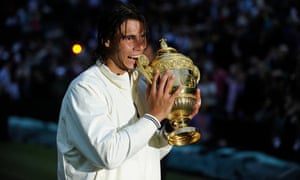
He had arrived in London from Mallorca midweek and headed straight for the shops to stock up for the fortnight in his rented house. Anyone who spotted a former two-times champion at the All England Club roaming the shelves for cornflakes in Wimbledon that day might have thought they had walked in on a photoshoot, but Nadal likes to stay rooted. It has kept him humble, which is not easy if you’ve earned $73m in prize money over 14 years, alongside endorsements and other deals that placed him 22nd on the Forbes Magazine list of the world’s best paid athletes in the year ending this month.
One detailed breakdown of his career earnings puts his net worth at about $125m.
Addressing that privilege, Nadal has had a foundation for eight years, inspired by his mother, Ana María.
“When I was a kid, my mam was always great helping people. I saw when I was young she was always to send money to different places for the kids. Talking with her, we decided to create a foundation.”
They began in Anantapur in India, among the dalits, or untouchables, and spread later to Barcelona, Zaragoza and Andalucía. “We aren’t going to change much but if all the people who have a lucky, privileged life can help a little bit then that is a lot of help. My foundation tries to help kids at risk of exclusion from society.”
Now he is taking the project home to Mallorca. “I feel very lucky all the things that I have, all the things that happen to me. So it’s just a small way to give back something. It’s a big project for me, with 25 tennis courts and places for the kids to live, with a school too, and a big gym, small football stadium, different sports, some indoor courts. It’s something that’s going to be part of my future, a lot of work. But I have the motivation. I love sport in general … And I love tennis.”
Did he never get tired of tennis? He did say at the O2 finals in 2011 – not one of his easiest campaigns – that he had “lost the passion” for it …
“That was a good but at the same time a very tough season. I lost a lot of finals. I lost the final in Indian Wells, I lost the final in Miami, I lost the final in Madrid, I lost the final in Rome, I won Roland Garros, but I lost the final here, I lost the final of the US Open. So, yes, you’re right. At the end of the season, you lose a little bit intensity, you lose a little bit of passion for the game. But, mentally, I got it back. I played Davis Cup in Spain. We won the final – and I started 2012 very well.”
So, was winning the spur to carrying on? “What drives me every day is the work. It is important to achieve goals, even if they are not big goals. You have to achieve the small objectives too. Winning? … In sport the victory is … ”
Everything? “Ha! No, not everything. But it’s very, very important. People only remember the victories. Our sport is not a sport of losses. You can lose hundreds of times, but the people only gonna remember the victories.”
But in some ways those who don’t win all the time do not have that pressure, no? He pauses. The right eyebrow goes north in sync with his closed mouth, as if dragged upward in wonder.
“It is obvious that the pressure for the top players to win almost every single match is completely different for the players a little bit lower ranked. But, at the end of the day, everybody wants to win. Every match is very competitive.”
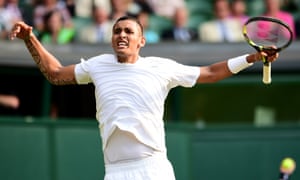
Yet losing to Nick Kyrgios here in the fourth round last year must have left at least a small psychic bruise. Nadal remembers it as he remembers beating Federer the first time they met, in Miami in 2004 – and the young Spanish kid won.
What is it like, then, going out to play these other great players, week after week: there he is again, that pesky Djokovic? Is there not a history that builds up?
“Yes, but at the same time … every moment in the year is different, every moment in your career is different. Every match depends on how [each player] arrives at that match.”
How did he cope with losing in Paris, then?
“It was less tough than in 2009 [when his parents separated and his tennis lurched this way and that]. I know that can happen – and it happened. I competed for one hour and 30 [minutes], and that is not enough to win against Novak. This season there have been more ups and downs, but the last couple of months I am playing better. And I intend to continue like this.
“It is not easy: six months, nearly, without playing tennis last year, injury. I lost a few matches this year that I shouldn’t have. When that happens a few times, it affects your confidence. When you come back from injury, it is important to win those matches that you can win or lose, to bring your confidence again and to feel that you are strong again.”
He runs through all his losses, in details with scores, and sighs as he says, “So there were a lot of matches that I should win: one week ago [against Alexandr Dolgopolov in the first round at Queen’s] 4-3 and serving with break in the first … If you are able to win these matches, the year changes and you have the chances to be in a better position in the ranking. You accept that, and when you change that, you are there again.”
So, can Wimbledon, the place of some of his finest hours and lowest moments, inspire him to halt the slide?
“On grass, every match is dangerous, every player is dangerous. If you play well, if you find the real rhythm, you can have a lot of fun. It is a feeling I have had a few years here in my career. It is very special. Obviously it is more difficult not being seeded top four. I am seed 10 because I didn’t play well enough and because I was out injured for six months last year. I am where I deserve to be now, and I hoped to be in a higher position back here. I am going to work for that, but what gonna happen gonna happen. I need to do it my way.”
